VTC Event Endorsment Briefing material
VTC Event Endorsement
From a date which is to be specified, all controllers must have completed the VTC Event Endorsment on moodle in order to man a position at VTC.
Access to Course
Course can be accessed below.
NO LINK. COURSE NOT YET COMPLETED
Upper ACC / ACC Planner
This section is about the responsibility of ACC planners
All UPPER ACCs are ACC Planners
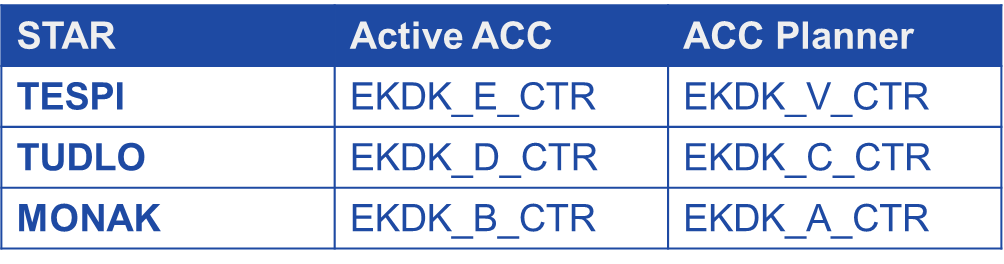
EKDK_A_CTR
Planner for EKDK_B_CTR
1 General
1.1 Responsibilities
Sitting on EKDK_A_CTR you have are generally responsible for climbs to NEXEN, and enroute traffic in Sector A/UA. While you have quite little traffic load your responsibility is heavy as you need to coordinate and plan traffic into the Brave sector. Something which is quite demanding
1.2 Sector Ownership
With EKDK_C_CTR online you may be advised to take Hybrid sector EKDK_A_CTR which gives you responsibility of EKDK_I_CTR to handle departures.
In case of arrivals above FL285 you are in charge of the holding.
2. Arrivals
Always have close cooperation with your Active ACC Sector (EKDK_B_CTR) and Flow Manager (EKDK_FMP)
2.1 General
Handling of arrivals are of significant important with emphasis on following situations
- Stacking of arrivals to FL270 from Mueritz to avoid LOS
- Re-Routing of EDYY arrivals as needed to avoid stacked holdings.
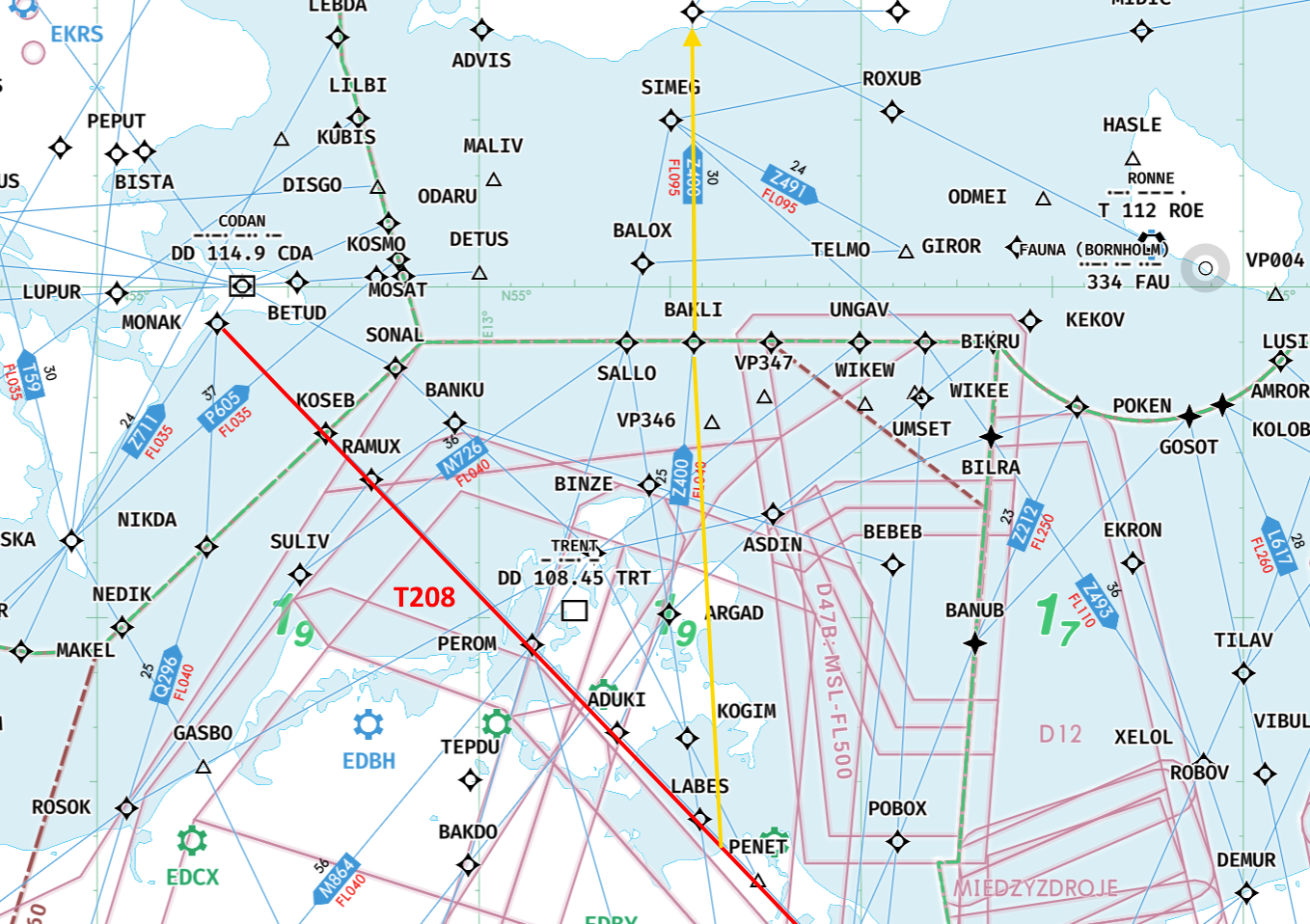
- Re-Routing of DWM arrivals far east via BAKLI-TIDVU
- Establish secondary holds at MEGAR and coordinate sequence.
- When holding established above FL280
- EDDH arrivals at FL230
2.2 Stacking for DWM
When you see flights from DWM at FL200 to MONAK starts getting difficult, stacking up to and including FL270 needs to be in effect. In that case contact EDWW_M_CTR and advise aircraft callsign and level. if flights are still at cruise level you may be able to do it directly via the TAG.
If you decide to stack flights above FL270 you will need to establish secondary holdings from EDYY/EDWW arrivals
Note that enroute holdings at NIKDA and KOSEB are NOT allowed due to proximity of OLPIB hold
2.3 Secondary holding at MEGAR
Flights from EDDH at FL230, and flights from EDYY when holding is stacked above FL280 is crucial. In this case you shall coordinate with EKDK_B_CTR to re-clear and hold at point "MEGAR". This will ensure clearance to OLPIB without busting EDWW/EDYY airspace.
You can choose to coordinate with EKDK_B or ask for the flights yourself to manage that holding.
At no times should more that ~10 aircraft be in OLPIB hold. If so, keep them on your frequency and hold them until load decrease at OLPIB.
When aircraft are holding at MEGAR, you MUST note and communicate to EKDK_B_CTR where in the sequence they fit in. Effectively this can be done by "Highlighting" the aircraft in OLPIB hold the aircraft in MEGAR hold will be Preceding. This allows EKDK_B to keep a hole in the holding at the level of the MEGAR hold, and then squeeze that aircraft into OLPIB hold when his turn in sequence as come.
2.4 Re-Routings
All Re-Routings MUST happen in communication with Flow Manager FMP
Re-Routing MAY also be directed by Flow Manager FMP
Re-Routings normally are either:
Re-Routings from EDYY/EDWW to TUDO
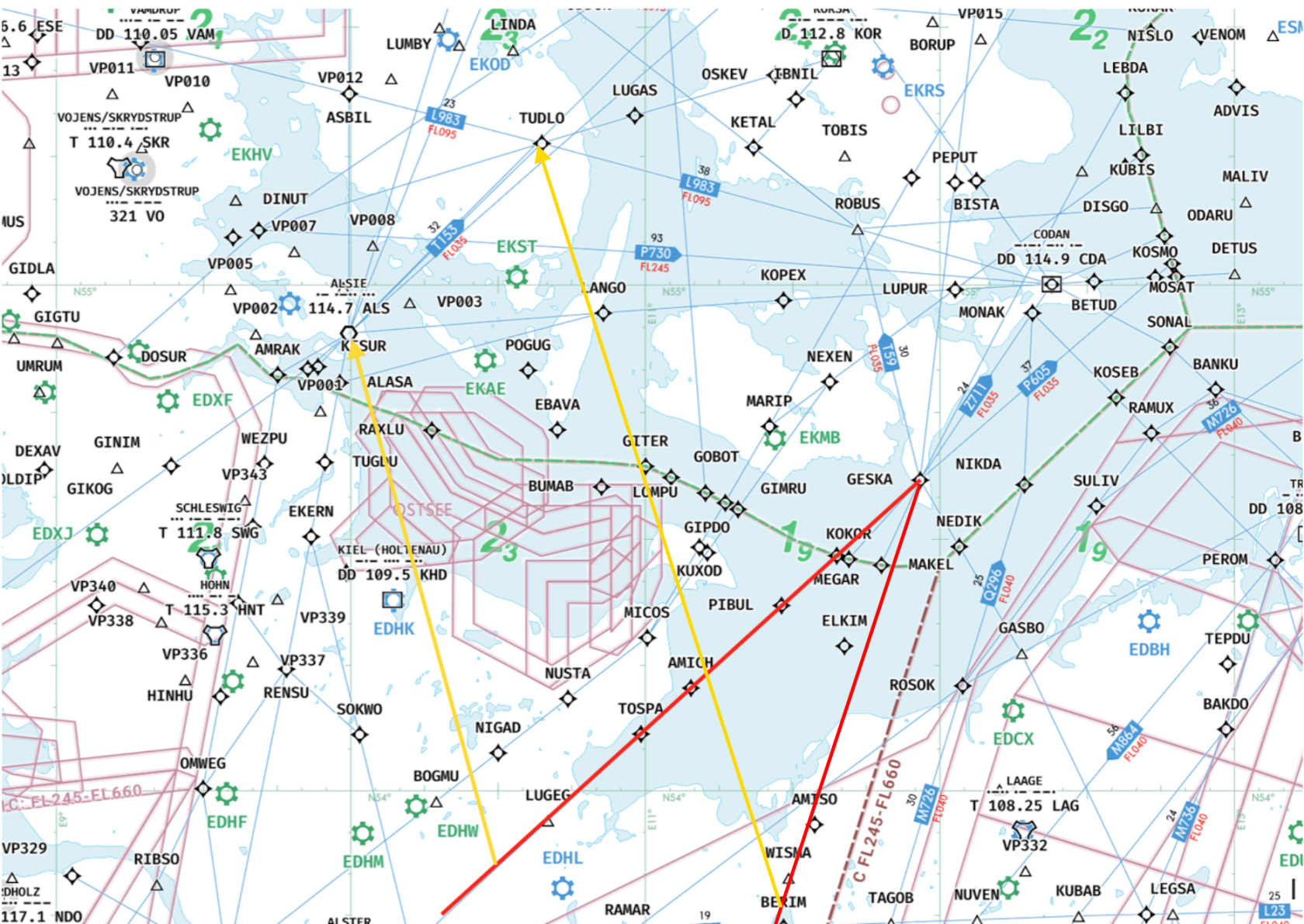
Re-Routings from DWM to BAKLI-TIDVU
It is prohibited to execute these re-routings without the clear consent from EKDK_FMP (if online)
EKDK_C_CTR
Planner for EKDK_D_CTR
1 General
1.1 Responsibilities
Sitting on EKDK_C_CTR you have are generally responsible for climbs to LANGO, ODDON, and enroute traffic in Sector C/UC.
1.2 Sector Ownership
With EKDK_D_CTR NOT online you may be advised to take Hybrid sector EKDK_C_CTR which gives you responsibility of EKDK_D_CTR to handle TUDLO arrivals all the way down.
With EKDK_A_CTR is NOT online you will also be given responsibility of ACC Copenhagen Sector I.
In case of arrivals above FL285 you are in charge of the holding.
2. Arrivals
Always have close cooperation with your Active ACC Sector (EKDK_D_CTR) and Flow Manager (EKDK_FMP)
2.1 General
Handling of arrivals are of significant important with emphasis on following situations
- Ensure not more that ~8-10 aircraft are under control of EKDK_D_CTR
- At high traffic situations, "Pre-Clear" aircraft on arrival and into holdings"
- Stay at close contact and help you EKDK_D_CTR as you see fit
2.2 Holdings
It is vital that EKDK_D_CTR is not overloaded by holdings. ~8-10 aircraft is maximum that should be in EKDK_Ds holding at any time. In order to help him out, stand holdings in excess of 8-10 above FL280. If space above FL280 gets tight, descent aircraft into EKDK_D_CTRs airspace while keeping control, and handover an ad-hoc basis
Altitude in the holding is always LESS critical than amount of aircrafts on the frequency
2.3 Lower Holdings
If you can see that inbound traffic rush is imminent, coordinate with FMP to establish holds at TUDLO below FL130 down to a minimum to FL80
2.4 Secondary holding at TALSA
In very heavy traffic situations and situations where we close down EKCH airspace for arrivals introduce TALSA hold on "current inbound track" with Right turns, 1.5 minute legs.
Here you start stacking aircrafts as needed until they can be released into ACC Lower East
2.5 Re-Routings
All Re-Routings MUST happen in communication with Flow Manager FMP
Re-Routing MAY also be directed by Flow Manager FMP
No regular Re-Routings are used from EKDK_C_CTR, but on Ad-Hoc basis flights may be re-cleared to either TESPI or MONAK if traffic situation demands it.
It is prohibited to execute these re-routings without the clear consent from EKDK_FMP (if online)
EKDK_V_CTR
Planner for EKDK_E_CTR
1 General
1.1 Responsibilities
Sitting on EKDK_V_CTR you have are generally responsible for climbs to GOLGA, and enroute traffic in Sector V/N/UN.
1.2 Sector Ownership
NIL
2. Arrivals
Always have close cooperation with your Active ACC Sector (EKDK_D_CTR) and Flow Manager (EKDK_FMP)
2.1 General
Handling of arrivals are of significant important with emphasis on following situations
- Ensure not more that ~8-10 aircraft are under control of EKDK_E_CTR
- At high traffic situations, "Pre-Clear" aircraft on arrival and into holdings"
- Stay at close contact and help you EKDK_E_CTR as you see fit
- Enforce Ground stop at EKBI, EKYT, EKAH, EKKA in coordination with FMP.
- If local ATC is online INFORM them on event start that all ATC clearances are subject to release by either you or EKDK_FMP (to be coordinated internally)
2.2 Holdings
It is vital that EKDK_E_CTR is not overloaded by holdings. ~8-10 aircraft is maximum that should be in EKDK_Es holding at any time. In order to help him out, stand holdings in excess of 8-10 above FL240. If space above FL240 gets tight, descent aircraft into EKDK_E_CTRs airspace while keeping control, and handover an ad-hoc basis
2.3 Lower Holdings
If you can see that inbound traffic rush is imminent, coordinate with FMP to establish holds at TESPI below FL130 down to a minimum to FL90
Altitude in the holding is always LESS critical than amount of aircrafts on the frequency
2.4 Secondary holding at AAL
Aircraft from ACC Polaris (ENOR, ENOS, ENSV)
In very heavy traffic situations and situations where we close down EKCH airspace for arrivals introduce AAL hold on "263 track" with Right turns, 1.5 minute legs.
Here you start stacking aircrafts as needed until they can be released into ACC Lower East
2.5 Secondary holding at BAVTA
Aircraft from ACC Scottish (EGPX)
In very heavy traffic situations and situations where we close down EKCH airspace for arrivals introduce BAVTA hold on "current inbound track" with Right turns, 1.5 minute legs.
Here you start stacking aircrafts as needed until they can be released into ACC Lower East
2.4 Re-Routings
All Re-Routings MUST happen in communication with Flow Manager FMP
Re-Routing MAY also be directed by Flow Manager FMP
Re-Routings from DK_V to ERNOV
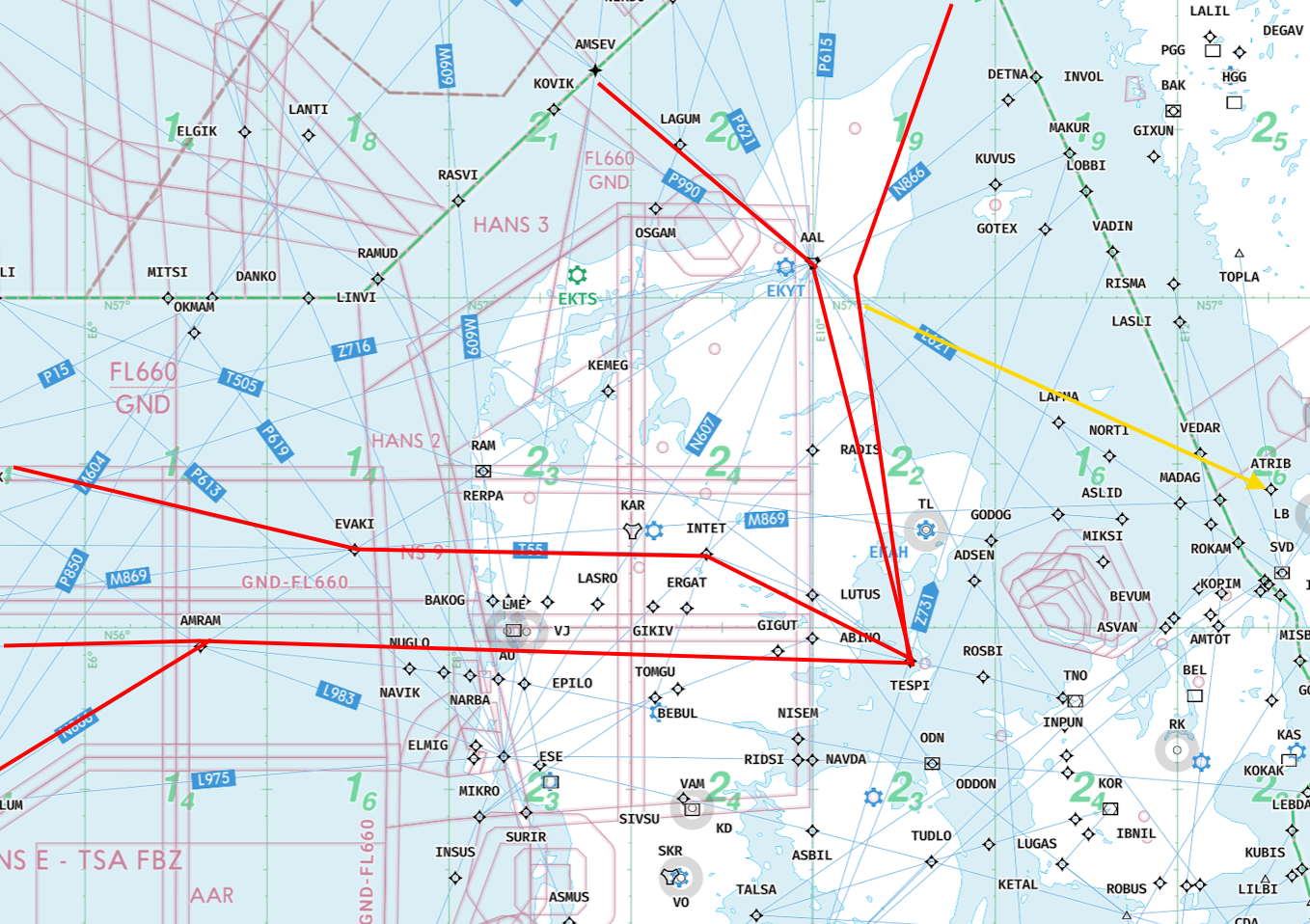
On an Ad-Hoc basis aircraft can be re-routed from TESPI to TUDLO
It is prohibited to execute these re-routings without the clear consent from EKDK_FMP (if online)
Kastrup Departure Position
1. General
Copenhagen Departure is an overflow sector during busy events. For much of the departing aircraft's trajectory, you will be a guest in the APP sector's airspace. This means coordination and tactical vectoring is very important.
Though the LAI states APP/DEP airspace is split at FL75, in practise DEP must position aircraft to climb above FL70, and APP needs to descend traffic in order to cross abeam the landing threshold at 5000ft. DEP is responsible for identifying the suitable crossing point - where departures pass above arrivals - and coordinating this with the relevant APP sector.
Consider the following factors:
Arrival Load.
Before taking a departure off the SID, look to see how the arrivals are being vectored and determine where departures will cross the flow.
If departures remain below the inbound flow, leave sufficient space for APP to descend traffic.
Performance.
The SIDs in Copenhagen all require a 6.6% climb gradient to FL70 - that's 400ft per nautical mile, or a climb rate of ~1700ft/min at 250kts.
At this angle, a departure will reach FL70 approximately 17nm after take-off. FL100 will be reached 25nm after take-off.
Most medium jets can manage ~2500ft/min, which delivers a gradient of roughly 10%, or 600ft/nm. Such departures will reach FL100 approximately 17nm after lift off.
With this considered, determine which strategy you will use for each departure:
- Shortest Route / Stepped Climb: relevant where a level-off is required to remain below arrivals. Use high speed below FL70 to reduce the climb gradient.
- Longer Route / Continuous Climb: relevant where the opportunity exists to pass above arrivals, even if departure routing is slightly longer. Instruct 250kt to maintain the 10% gradient until clear of the conflicting arrival.
2. Procedures - Runway 04
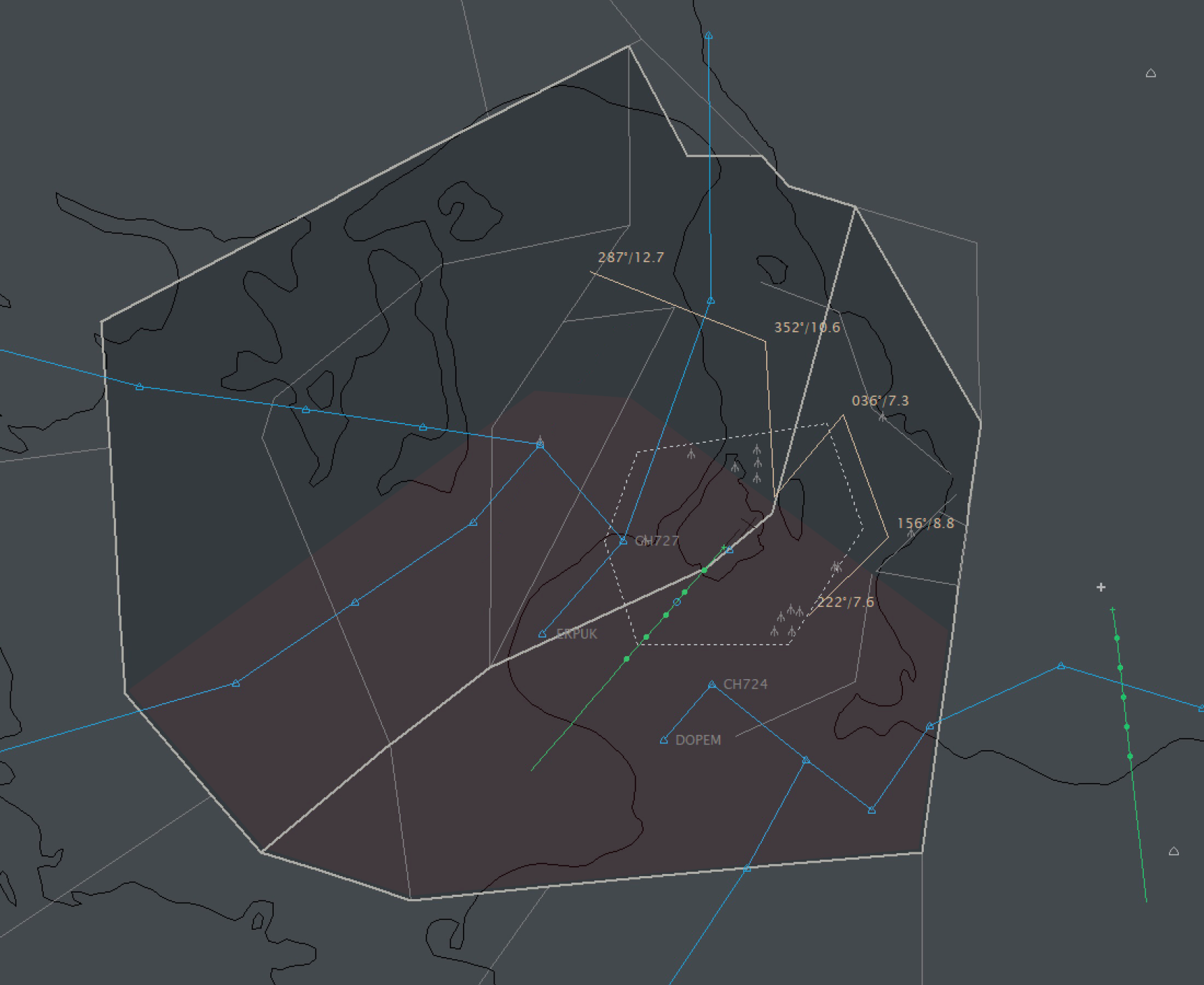
Departures should avoid routing below FL70 in the red shaded area unless coordinated with APP
GM for R DEP (W APP)
- ODDON
- GOLGA / VEDAR
Two climb opportunities exist, the one you use depends on traffic load under radar vectors in the TMA and density of ERNOV arrivals.
- HDG 350 until above ERNOV flow then DCT - separated from all arrivals, requires high climb gradient to FL110
- SID or HDG 290 after until passing ERNOV flow then DCT - shorter route, lower required gradient but interaction with downwind traffic and W APP vectoring area
GM for K DEP (O APP)
- KEMAX
- SIMEG / SALLO
- NEXEN / KOPEX / SALLO
All conflicting departures must climb above O APP arrivals before passing abeam CH845.
- HDG 100-140 until above TIDVU flow then HDG 180-210 until above MONAK flow
- shorter route but interacts with arrivals, requires at least 2500ft/min to FL100 - Remain on SID until above FL80 then DCT
- longer route, standard gradient must be maintained - HDG 040-070 until above FL60, then follow option 1.
- use where the 6.6% gradient cannot be maintained, or when O APP has vectored arrivals north of CH845
3. Procedures - Runway 22
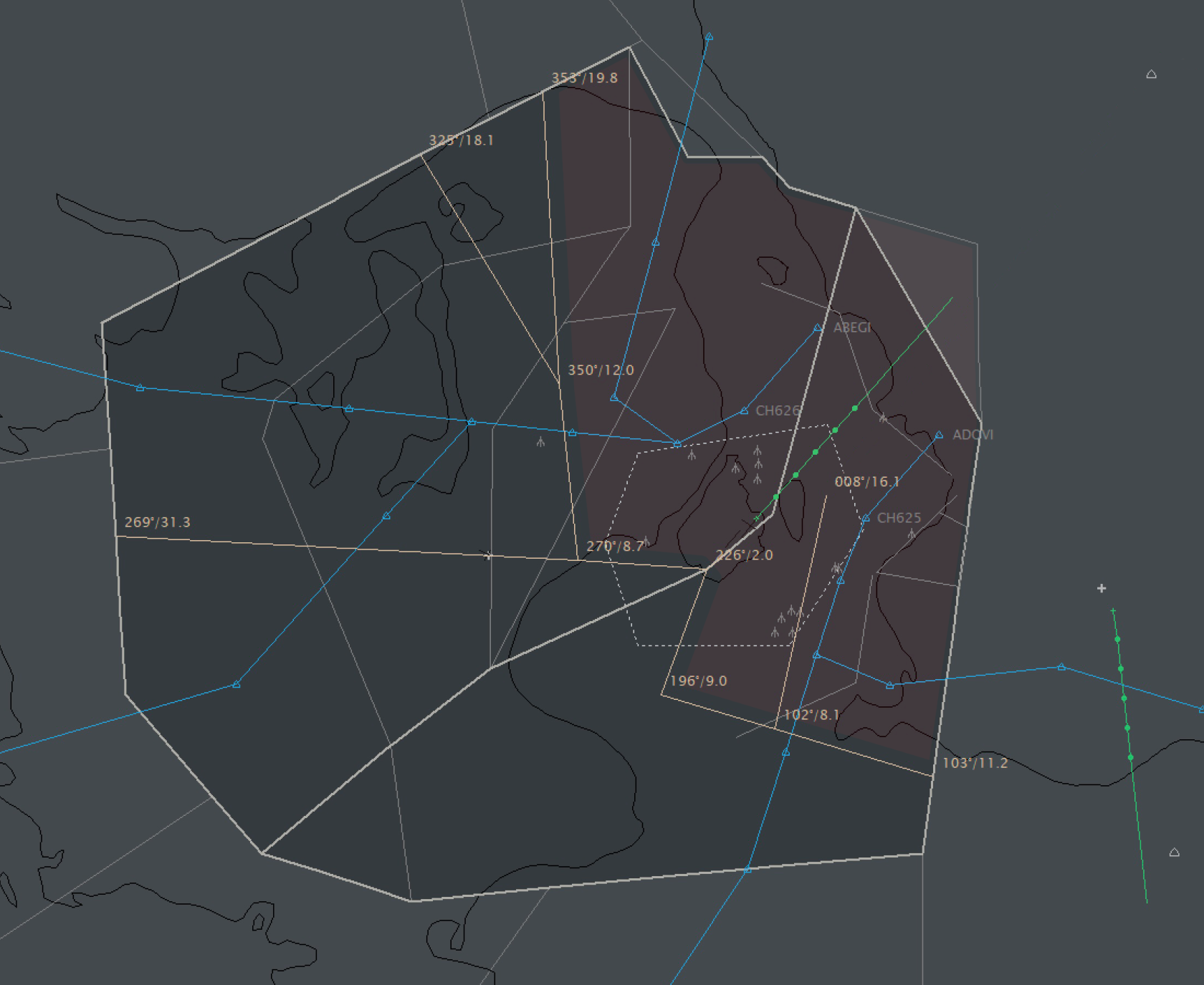
Departures should avoid routing below FL70 in the red shaded area unless coordinated with APP
GM for R DEP (W APP)
- ODDON
- GOLGA / VEDAR
Thread the departures through the arriving traffic - coordinate the crossing point with W APP based on the arrival load
- HDG 250-270 until above TUDLO / TIDVU flow then DCT
- separated from all arrivals, requires high climb gradient to FL130 - SID until after passing TUDLO/TESPI flow then DCT
- appropriate when TUDLO flow are skipping CH645, so you pass under them - HDG 290-310 until passing TESPI arrivals then DCT
- shorter route, lower required gradient but interaction with downwind traffic and W APP vectoring area
GM for K DEP (O APP)
- KEMAX
- SIMEG / SALLO
- NEXEN / KOPEX / SALLO
All KEMAX departures must climb above O APP arrivals before turning north
- HDG 180-210 or SID to CH818 until:
- KEMAX: DCT when above FL60. SID is not separated from MONAK flow.
- SALLO / SIMEG: DCT when above FL100
- SID until passing MONAK flow then DCT - for SALLO/SIMEG only
VTC Event - Recency
Apart from have completed the training material for the position desired, following recency rules are in effect when sitting at Vectors to Copenhagen
EKCH_F_APP
For controllers wishing to man EKCH_F_APP during VTC during official bookable times, following extra requirements are in effect:
- Controller must have been online during VTC on an S3 position or higher during the preceeding 3 events before the event where he desires to book EKCH_F_APP
EKDK_B_CTR
For S3 controllers with EKDK SOLO ENDORSEMENT wishing to sit on EKDK_B_CTR during VTC during official bookable times, following extra requirements are in effect:
- MML endorsement must have been taken during S3 period
FINAL
Speed Control
Speed control is different from executing base turns
It is Much easier to do!
It is much harder to trust!
To succeed to must be able to give proper speed control. Not too much, not too little, but preferibly EXCACTLY as I will now describe it... Its a step by step recipe devided into
- Downwind checking in
- Turning Base more than 10 miles
- Turning Base less than 8 miles
- Intercepting ILS
- Established ILS
- Within 10nm
- Within 6nm
Lets begin! The different topics are short.
Downwind checking in
Airplanes SHOULD be handed over by EKCH_W_APP/EKCH_O_APP maintain 220kts. if less then its for small corrections, and will make no difference.
you first principle lesson is this:
DO NOT change that speed!!!
The video explained it, I will not explain it again, do not reduce speed so early. It creates troubles you cannot yet see.
220 should be kept until the very moment a base turn is commenced, and should only be different if you have a VERY good reason and is a skilled F_APP controller.

Turning Base more than 10 miles
Normally (Almost always) when you give a base turn it will be for a minimum of 8 mile final or longer from 2500 feet or higher, and in this case...
The base turn is where you reduce the speed to 200kts.
Don't do less, don't do more, but trust that this is a great speed to work with!
By the way remember to descend them to platform altitude no later than here. preferibly descend them even when they check in
Are there any cases where I should NOT use 200kts on base???
Glad you asked... Yes there is! You may consider less or more when:
- Crosswind of more than 15 knots expected
- e.g. 22L in use wind 150 at 16 knots. You can expect strong tailwind on right base
- In above case assign 180-190 on the segment with high tailwind base
- Keep 200 on the headwind base
- Consider 210 in really strong crosswind.
- Other case where you should use another speed is the case described below
Turning Base less than 8 miles
Sometimes we give a 6 miles final @ 2000' or even 5 miles final @ 1500'. In this case the base leg is situated around 8 miles from the runway, and thats just too close to the runway to have 200kts.
In this case, reduce straight away to 180, or at least be ready to reduce to 180 when established on base.

Intercepting ILS
When intercepting the ILS is the next thing thats a lesson in trust!
Do NOT change the speed until he is established, and you can see excactly how close you are to the 3nm separation between airplanes.
Only if you see you are below 3nm on an intercept should you reduce speed. Like here:
Established ILS
Once established on the ILS, it is probably time to reduce the speed.
It depends however on the distance to the aircraft in front.
If aircraft in front is still far ahead?
Keep 200 until 10dme, and then reduce to 180, or 160.
If aircraft in front is a factor
Reduce to 180 when on the localizer, to allow to keep distance to preceeding. Eventually preceeding will slow to 160, and he will catch up to 3nm separation.
If aircraft in front is 3nm ahead
Match the speed to him. But do not go 160 until within 10nm final, otherwise you will slow the aircrafts behind too much.
Within 10nm
Regardless of separation, and aircraft should be reduced to 180 no later than 10nm final
Within 6nm
Regardless of separation, and aircraft MUST be reduced to 160 no later than 6nm final as pr. ICAO DOC 4444.
Issuing 160 until 4DME is always the best thing!
180 until 6DME is also an approved option
Base turns
Giving the base turn at the perfect moment is tricky, but you have to first of all train yourself to not hesitate. It is earlier than you think.
Remember to be ready to put an aircraft on a vector, if you base turn appears later than the Vectors fix (ABEGI,ADOVI,ERPUK,DOPEM)
Regular base turn
The regular base turn is the easierst and most predictable. However, it also takes away a lot of flexibility. Once he is on base, he is easily more commited to the final turn.
Therefore knowing WHEN to issue that base turn to have a perfect 3nm separation is important. Lets look at some different situations to help you.
1 - Basic Base turn with preceding already on final
This is by far the easiest. Situations is
BMA2060 on base, speed 220
NSZ81E on final, speed 200
BMA2060 Radar target (Square) is passing NSZ81Es point of his 3nm arrow pointer.

Thats when to turn base. You have a window of +/- 5 seconds to issue the instruction.
You can even issue it slightly before if you like. Especially if you feel it is a slow pilot.

Now BMA2060 is on base, As you see in red you have to evaluate his arrow pointer to the radar target of NSZ81E. Normally it will be enough to an almost immediately turn to intercept.
Blue denotes his 3nm pointer if he had turn directly inbound. There would still have been distance to spare.
Therefore do not hesitate. Give him the inbound turn.
Note at this point NZS81E is 180 as he should be on localiser, and BMA2060 is 200 as he should be on base, so the speed difference will help!

As the inbound turn is given the distance is 3.3nm.
NSZ81E speed is 160 until 4DME
BMA2060 is reduced to 180 as he is inside of 10nm final.
The speed difference will equalize to the fact that becuase BMA2060 has still an intercept heading, separation would normally increase.
Keep BMA2060 on 180 until he is established.

They are established, separation is 3.2 nm. Thats fine!!
Reduce to 160 and handover to TWR. Thats it!
Remember!
When aircraft target passes preceedings 3nm arrow point, turn base!!
2 - Base turn with preceding on intercept
This is relatively easy. You do the same as above, because on intercept there is so little extra track miles, that its a matter of seconds for the turns. Just keep it simple and stick to same procedure as above.

Again, its fine to issue the instruction even a few seconds before!!
3 - Basic Base turn with preceding also on base
This is tricky. You have two different scenarios. From same side or opposide side
Opposite side
Here you have two airplanes on same downwinds, BEL5EP already has base turn instructed. WHEN do you turn in TSA1631??

You just gotta get a feeling for it. Learn how long time it takes for people to start their base turn after instruction is given. and then you must:
Issue the instruction so that base turn from TSA1631 is COMMENCED when is passing the extended base path of BEL5EP

Now they should be flying towards eachother but a slight offset. Be carefull with altitudes here. It is easy to mistakenly create Loss of Separation here.

As you turn BEL5EP. BE READY!! To turn TSA1631 inbound right after. It is very difficult to judge but use best judgement on where the 3nm arrow of TSA1631 is, to judge. Lets go through it.

AAs soon as BEL5EP starts the turn, you can see that TSA1631 already has more than 3nm. This is normally because:
Since TSA1631 was number 2 it was likely turned on base slightly later, hence is further from Localizer than BEL5EP. Take into consideration the ~2nm offset, then the difference in location from localizer gives the last mile, and you can turn TSA1631 in immediately after


It worked!!