2
LAI concerning with AOR, Responsibilities and various procedures for sitting on Kastrup TWR position
1. Controller Positions
1.1 Aerodrome controllers at Copenhagen Kastrup are split into four categories:
a) Tower
b) Ground
c) Apron
d) Delivery
1.1.1 The Tower and Ground controllers sit in the upper cab of the tower, while the Apron and Delivery controllers sit in the lower cab.
1.1.2 All positions with callsign "Kastrup Tower" require the S2 rating.
Login Callsign | Radio Callsign | Frequency | Position | Notes |
|---|---|---|---|---|
EKCH_A_TWR | Kastrup Tower | 118.105 | TWR–ARR | |
EKCH_D_TWR | Kastrup Tower | 119.355 | TWR–DEP | |
EKCH_GW_TWR | Kastrup Tower | 118.580 | GND–W | |
EKCH_GE_TWR | Kastrup Tower | 121.830 | GND–E | |
EKCH_A_GND | Kastrup Apron | 121.630 | APN–ARR | |
EKCH_B_GND | Kastrup Apron | 121.905 | APN–SEQ | |
EKCH_C_GND | Kastrup Apron | 121.730 | APN–DEP | |
EKCH_DEL | Kastrup Delivery | 119.905 | DEL |
2. Area of Responsibility
1.1. Kastrup CTR
1.1.1.1. Kastrup Tower provides air traffic service in Kastrup CTR (GND-1500 ft). Kastrup CTR is Class D Airspace.
1.1.1.2. AREA KASTRUP (GND-1500 ft) located within Sweden FIR is a part of Kastrup CTR. The area is permanently delegated from Sweden FIR.

1.2. Maneuvering Area
1.2.1.1. The maneuvering area is defined as the zone extending from the holding points of RWY 30 and RWY 22L, and includes all other runway holding points.
1.2.1.2. The maneuvering area is always controlled by a controller with callsign "KASTRUP TOWER".
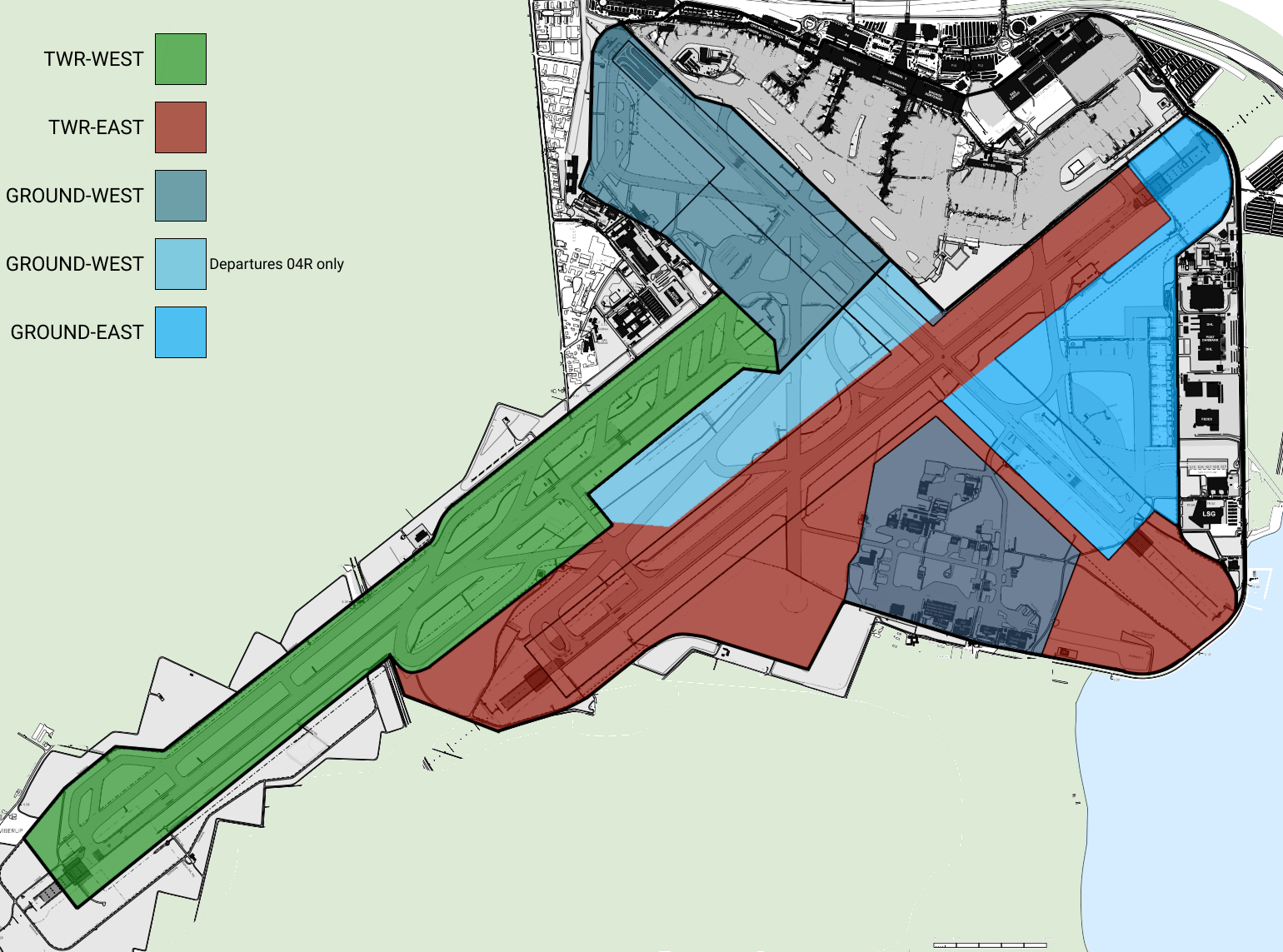
1.2.1.3. Areas are designated into GROUND areas and TOWER areas.
1.2.1.4. These areas are split into four physical areas of responsibility called:
- Tower West (TW)
- Tower East (TE)
- Ground West (GW)
- Ground East (GE)
1.3. Apron Area
1.3.1.1. Four aprons in Copenhagen, defined as areas of the airport outside the movement area.
- Apron North
- Apron East
- Apron South
- Apron West
1.3.1.2. Apron East/South and West are under the control of GROUND EAST.
1.3.1.3. Apron North is under the control of KASTRUP APRON
1.3.1.4. KASTRUP DELIVERY is supplying Clearance Delivery service for all aprons, unless otherwise coordinated. DEL does not supply ATC clearances for VFR traffic at holding points.
1.3.1.4. KASTRUP APRON is supplying Start-up approval service for all aprons, unless otherwise coordinated.
1.4. Upper Cab (S2 rating req.)
1.4.1. General
1.4.1.1. Upper cab consist of four positions controlling the four different areas depending on Runway Configuration.
Position | Frequency | Norm. ES Identifier | Radio Callsign |
TWR – DEP | 119.355 | EKCH_D_TWR | Kastrup Tower |
TWR – ARR | 118.105 | EKCH_A_TWR | Kastrup Tower |
TWR – GW | 118.580 | EKCH_GW_TWR | Kastrup Tower |
TWR – GE | 121.830 | EKCH_GE_TWR | Kastrup Tower |
TWR - CO | NOT IN USE | ||
1.4.1.2. Areas TWR-EAST and TWR-WEST are not tied to a frequency and will be assigned to TWR-DEP and TWR-ARR depending on runway configuration as specified in LAI5-LAI8.
1.4.1.3. Areas GRUND EAST and GROUND WEST are generally tied to their respective frequencies.
1.4.1.4. Position TWR-DEP and TWR-ARR are interchangable and will take over from eachother.
1.4.1.5. Position TWR-GW and TWR-GE are interchangable and will take over from eachother.
1.4.2. Designation of repsonsibility
1.4.2.1. Areas GROUND-WEST and GROUND-EAST, will generally be allocated to a GROUND controller.
1.4.2.2. Areas TWR-WEST and TWR-EAST, will always be allocated to a TOWER controller.
1.4.2.3. In case of no online TWR-GE or TWR-GW, TWR-EAST will assume responsibility of GROUND EAST
1.4.2.4. In case of no online TWR-GE or TWR-GW, TWR-DEP will assume responsibility of GROUND WEST, subject to coordination allowances of LAI 5-8.
GM to 1.4.2
(a) GE and GW are GROUND areas, only responsible for taxiing aircraft to holding points and provide sequencing for departure and arrival. These areas will never inherit responsibility for takeoff and landings.
(b) TE and TW are TOWER areas, responsible for issuing takeoff and landing clearances.
(c) TE and TW are allowed to provide top-down coverage of GROUND areas when required due to offling GE+GW.
(d) GE and GW are NOT allowed to provide coverage for any TOWER area.
1.5. Lower Cab (S1 rating req.)
1.5.1. General
1.5.1.1. Lower cab consist of four positions controlling APRON NORTH as well as Delivery and Start-up service.
Position | Frequency | Norm. ES Identifier | Radio Callsign |
CLR DEL | 119.905 | EKCH_DEL | Kastrup Delivery |
APRON (TAXI IN) | 121.630 | EKCH_A_GND | Kastrup Apron |
APRON (STARTUP) | 121.905 | EKCH_B_GND | Kastrup Apron |
APRON (OUT TAXI) | 121.730 | EKCH_C_GND | Kastrup Apron |
2. Usage of Runways
2.1 Selection of Runway in Use
TWR-DEP and TWR-ARR shall select the appropriate Runway in use in relation to the meteorological conditions.
2.1.1. Runway in use 0600-2300 CEST.
2.1.1.1. Runway 04R/04L or Runway 22R/22L shall be selected as the primary runway configuration. Either Runway may accept up to a 5 knots tailwind component.
2.1.1.2. In the case above, the right runway shall be used for takeoffs and the left one used for landings.
2.1.1.3. Runway 12/30 may only be selected as takeoff and landing runways if one of the following conditions are present:
- Crosswind Component greater that 15kts on any other runway
- RWYCC 4 or less on the main runways
- Snow removal
- NOTAMs or operational requirements as per operational bulletin
GM to 2.1.1
(a) Reference Flightradar24 as well as METAR/TAF sources to select most suitable Runway in use.
2.2.1.4. Runway 30 may be used for landing without restriction as needed, but shall not be selected as a main runway.
2.2.1.5. Runway 12/30 and the main runways may be used in conjunction with each other in accordance with the terms and configurations specified in LAI5-8.
2.1.2. Runway in use 2300-0600 CEST.
2.1.2.1. Runway 04R/04L or Runway 22L shall be selected as the primary runway configuration. Either Runway may accept up to a 5 knots tailwind component.
2.1.1.2. In the case above, the 04R shall be used for takeoffs and Runway 04L shall be used for landings in an easterly configuration and Runway 22L shall be used for takeoff and landings in case of westerly configuration.
3. TWR-DEP Responsibilities
3.1 General
3.1.1.1. TWR-DEP (Normally known as EKCH_D_TWR) is responsible for all movements on the designated departure runway.
3.1.1.2. Issue correct amount of departure separation with regards to:
a) SIDs
b) Wake Turbulence
c) Performance capabilities
d) Flow meassures
e) Other non-foreseen issues
3.1.1.3. TWR-DEP is responsible for exercising the responsibilith of TWR-ARR when that position is unstaffed.
3.1.1.4. TWR-DEP assumes responsibility for GW and GE when required in accordance with LAI 5-8.
3.1.1.5. TWR-DEP is responsible for coordination with the relevant departure controller before departure of any given aircraft which:
a) Is IFR without an SID
b) Is IFR with a CFL lower than initial climb out of EKCH
3.1.1.6. TWR-DEP is responsible for correct coordination with other units as pr. LAI 4 of this collection
3.1.1.7. TWR-DEP is responsible for assuring adherance to automatic handover to K/R_DE.
GM to 3.1.1.7
(a) TWR-DEP should to greatest extent advocate for good airmanship by not describing frequencies to pilots, except when specifically prompted.
(b) TWR-DEP should preferibly add a greeting to a takeoff clearance to signify terminating communication e.g.
- "Bye", "Goodbye", "Have a nice flight", "See you next time" or similar
(c) TWR-DEP may choose to add "When Airborne contact departure" to pilots deemed not capable of knowing departure frequency.
(d) Excact frequency should avoid being given if possible
(e) TWR-DEP should be familiar with Frequencies for Departure controllers EKCH_R_DEP and EKCH_K_DEP.
if in doubt, the freq. are shown here :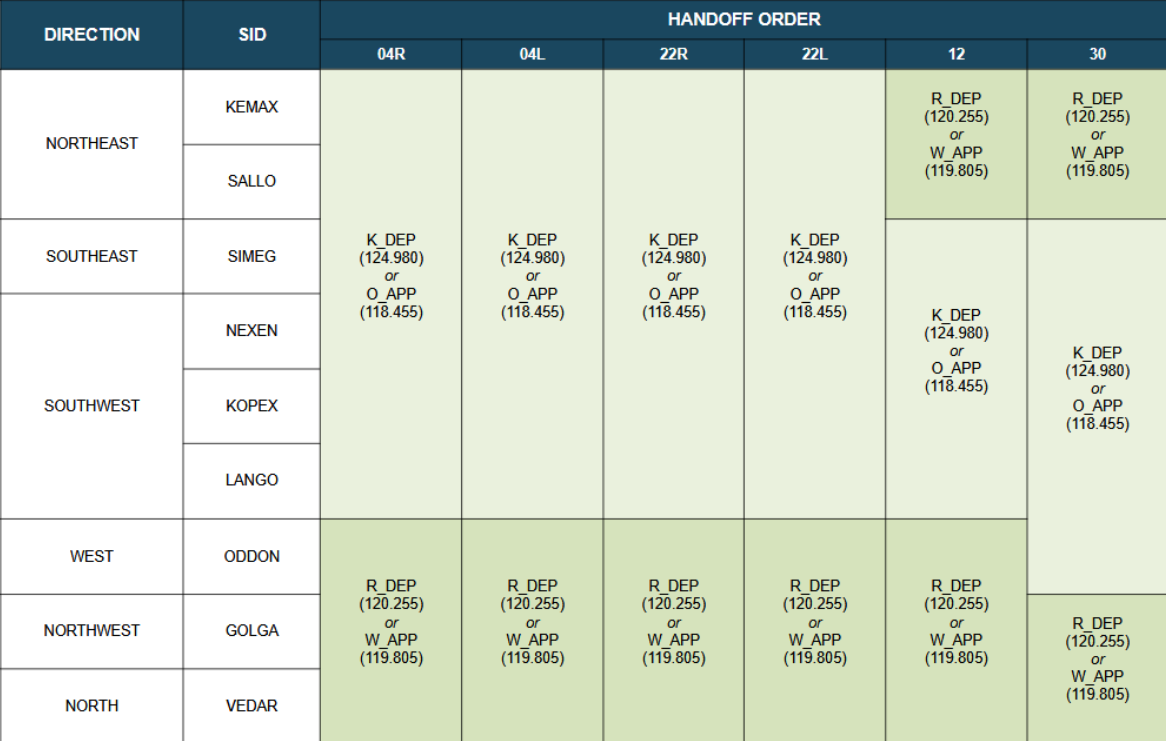
3.1.1.8. TWR-DEP is responsible for providing any non-standard frequencies for departing aircraft upon delivering takeoff clearance
GM to 3.1.1.8
(a) Non-standard handover include
(i) Copenhagen Control (ACC)
(ii) Departure not flying on SID
3.2 Usage of FLIGHTSTRIPS
NIL
4. TWR-ARR Responsibilities
4.1. General
4.1.1.1. TWR-ARR (Normally known as EKCH_A_TWR) is responsible for all movements on the designated arrival runway.
4.1.1.2. TWR-ARR is responsible for the initial portion of the inbound taxi-in clearance in accordance with the RIU described in LAI 5-8 of this collection
3.1.1.3. TWR-ARR is responsible for exercising the responsibilith of TWR-DEP when that position is unstaffed.
3.1.1.4. TWR-ARR assumes responsibility for GW and GE when required in accordance with LAI 5-8.
4.1.1.5. TWR-ARR is responsible for correct coordination with other units as pr. LAI 4 of this collection
4.1.1.6. TWR-ARR is responsible for coordinating Missed Approaches with the appropriate approach controller, as well as «Touch and Go» and «Low Passes» for IFR airplanes
4.2. Reduced separation Procedures (2,5 nm)
4.2.1.1. Reduced separation Procedure may be activated by FINAL and allows FINAL to reduce separation to a minimum of 2,5 nm on final inside of 10nm of the ILS.
a) TWR-ARR is advised that Reduced Separation Procedures is in force and will advise planes to expedite vacating
b) No tailwind or extreme crosswind is observed on the approach
c) 22L or 04L must be the runway in use for landing
d) Departures are handled by a separate TWR controller
d) Wake turbulence separation minema are met
d) Breaking action GOOD or better.
4.3. Usage of FLIGHTSTRIPS
NIL
5. TWR-GW Responsibilities
5.1. General
5.1.1.1. TWR-GW controls taxiing airplanes and is responsible for inbound and outbound feeding to correct holding points and feeder points for subsequent controllers.
5.1.1.2. TWR-GW will never issue takeoff or landing clearances. it serves only as manager in the movement area to:
a) Sequence Departures depending on CTOT, SID and other factors
b) Distribute arriving aircraft to the correct feeder points to Apron
c) Being the communicative link between Apron and the two Towers
5.2. Cross Coupling
5.2.1.1. TWR-GW will, in leau of TWR-GE being offline, automatically assume responsibility of both areas GROUND-WEST and GROUND-EAST, its frequencies, and area of responsibility.
5.2.1.2. The above restriction can be waived upon controller coordination as specified in LAI 3.
5.3. Usage of FLIGHTSTRIPS
NIL
6. TWR-GE Responsibilities
6.1. General
6.1.1.1. TWR-GE controls taxiing airplanes and is responsible for inbound and outbound traffic via and on APRON EAST and APRON SOUTH.
6.1.1.2. GE may utilize Runway 12/30 in full, to taxi inbound and outbounds, provided coordination with TWR-EAST for crossings of Runway 22L/04R is respected.
6.2. Cross Coupling
5.2.1.1. TWR-GE, will in leau of TWR-GW being offline, automatically assume responsibility of both areas GROUND-WEST and GROUND-EAST, its frequencies, and area of responsibility.
5.2.1.2. The above restriction can be waived upon controller coordination as specified in LAI 3.
6.3. Usage of FLIGHTSTRIPS
NIL
7. VFR Flights
7.1. General
7.1.1. Flightpath
7.1.1.1. VFR traffic can be instructed to follow ELLEHAMMER route if not going to airport.
7.1.1.2. If approach is planned to the airport the preferred routing is southern patterns to 04R/22L.
7.1.1.3. In case of high load of arrivals, it is allowable to use 04L/22R as desired.
7.1.1.4. TWR-ARR should generally be the one in control with VFR unless otherwise coordinated regardless of Runway configuration.
7.1.1.5. In case of 04R for VFR, TWR-ARR coordinates each pattern with TWR-DEP. This is because proper traffic information of arrivals is considered more important than unifying Rwy AOR.
7.1.2. Procedures
7.1.2.1. Squawks are not required for flights within and outside of the Controlzone.
8. Helicopter procedures
8.1.1.1. Helicopters operations can be executed from EKCH or HEMS/Rigshospitalet. No other takeoff and landing area is permitted within Kastrup CTR for helicopters
8.1.1.2. Helocopters are allowed on all Runways, as long as a «Starting Distance» is declared (positions found in charts)
8.1.1.3. Start on Runway 30 may happen from G2 as well
8.1.1.4. Starts must generally be commenced in the direction of the Runway, however helicopter departures may depart from
a) Runway 22L, in direction 04
b) Runway 30, in direction 12
8.1.1.5. After departure all helicopters must pass 600’MSL before turning
8.1.1.6. Landings on Rigshospitalet is outside of TWRs responsibility, and is therefore on the descretion of the pilot. An ATC clearance should though be obtained concerning direction and max altitude before the pilot departs from Rigshospitalet
9. Low Visibility Procedures procedures
For Low Visibility Procedures concerning APP Copenhagen, please refer to APP COPENHAGEN LAI 2 + LAI 3
9.1. Implementation
9.1.1.1. With visibility <800m Low Visibility Procedures may be implemented on descretion of TWR-DEP/TWR-ARR
9.1.1.2. Implementation must be communicated with APP Copenhagen, APRON and Pilots through ATIS NOTAMs
GM to 9.1
Implementation of low visibility is a encouraged but voluntary procedure on VATSIM.
Requirement to implement Low Visibility Procedures (LVP) is only related to the RVR reported, not cloud base or meterological visibility
TWR-ARR may select to implement low visibility procedures earlier if needed due to inability of aircraft to execute CATI approach. This may be in circumstances of cloud base of Vertical visibility being less than 200ft (CAT I DA).
A pilot may always be allowed to execute a CATII or CATIII approach at descretion of pilots and communicated to approach, but may not have the critical safety areas assured as required during LVP ops.
9.2. Use of Ground Radar
9.2.1.1. During utilization of LVP, Ground radar may not be used as the sole reference for takeoff and landings
9.2.1.2. In reference to point above, pilot reports are critical and should be requested in following circumstances
a) Report of Runway Vacated
b) Report of Rolling for departure
c) Report of passing taxiway points when condition requires as per.
9.3. Supplementary Procedures for RVR<800m
9.3.1.1. During utilization of LVP, landing clearance must be issued no later than 2nm before runway threshold. A failure to do this must result in execution of a missed approach.
9.3.1.2. Standard taxi routes are ammended so to all aircraft avoids taxiing on Runway 12/30 between B and 12 start. Reference LAI4 - Coordination Agreements for standard handover routes in LVP.
9.4. Supplementary Procedures for RVR<400m
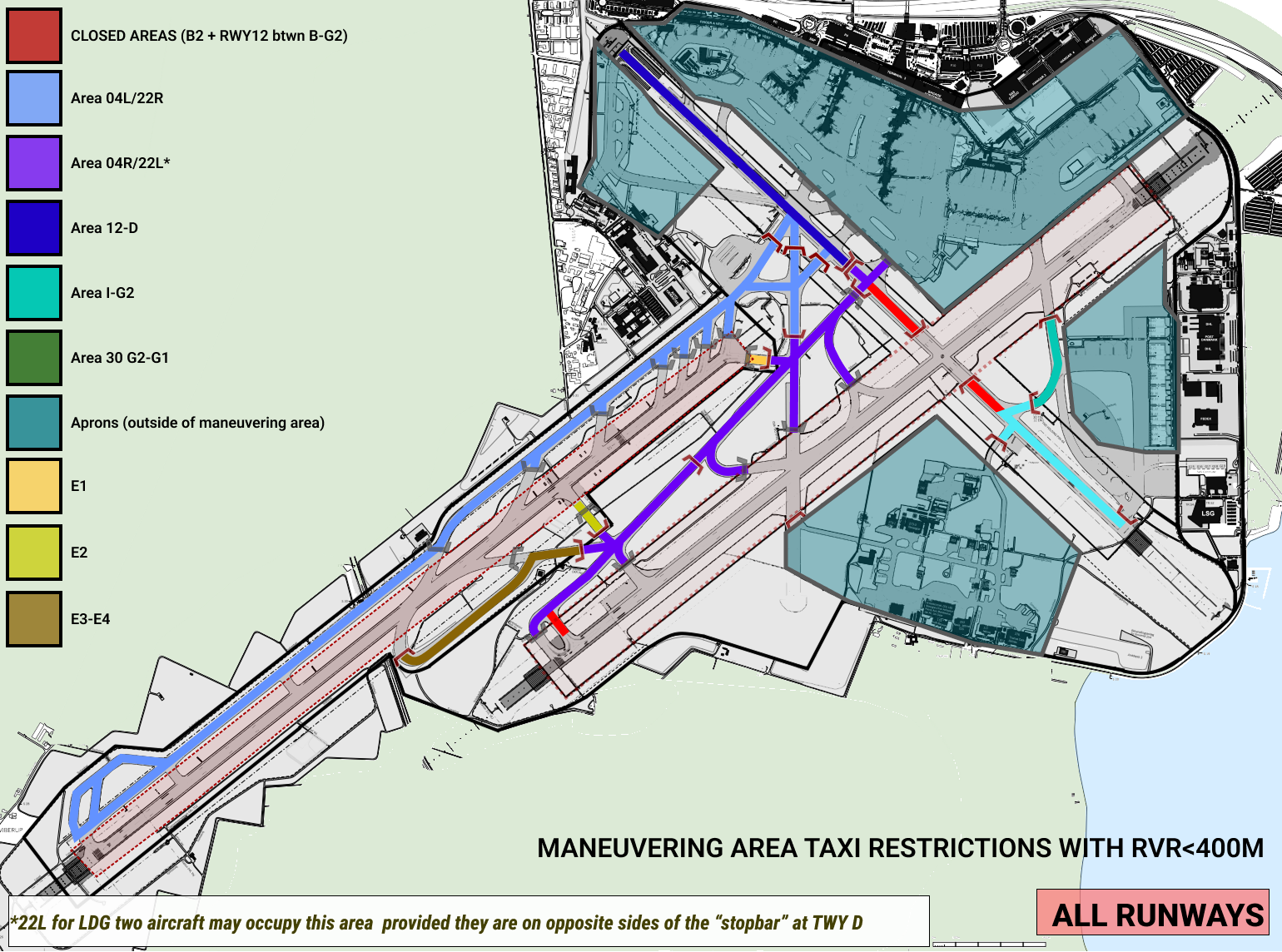
9.4.1.1. When RVR <400m supplementary procedures are in effect which imposes restrictions of taxi routes, as per Appendix A to Chapter 9.
9.4.1.2. Only one (1) aircraft may occupy each area at any time. an aircraft must have left one area before another aircraft may enter that area. This restriction shall lead to following considerations:
- Consider "long rollout" on Runway 04L to minimize time in area between RWY 12 and A7.
- Do NOT require pilots to vacate B4 in order to satisfy requirement when 22L is in use. Instead require to vacate B3 or later.
- RWY 12/30 between B and G2 are not allowed for taxi.
- TWY B2 is not allowed for taxi