
Norway Offshore Guide
Introduction
Norway sees a lot of offshore helicopter traffic related to the oil and gas industry. CHC Helikopter Service and Bristow Norway operate regular scheduled flights between mainland bases and oil fields along the entire norwegian coast. These operators also fly SAR flights on contracts from the norwegian government.
Offshore helicopter procedures are somewhat specialized and tailored to the risks and challenges involved with flying far out over the seas in harsh enviroments. This guide is intended as a simplified summary of the unique helicopter procedures, flight planning procedures and radiotelephony used in offshore flying, for pilots and ATC wanting to simulate it on the network.
Sources: Avinor Helicopter Manual, AIP Norway, EASA EAR for Air OPS, FAA AC 90-80C
General
Flightplan requirements
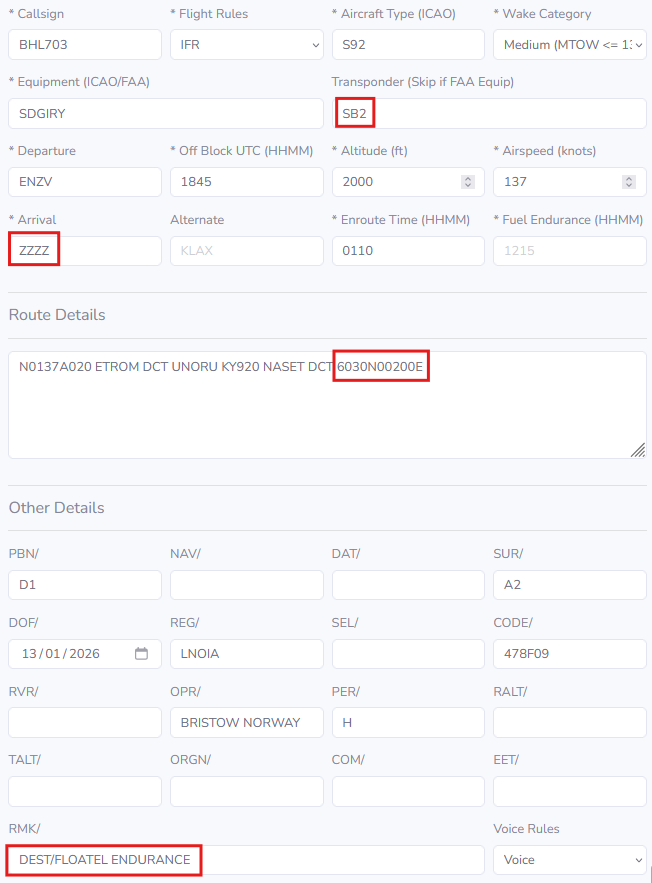
All offshore helicopters operating within Balder, Ekofisk, Statfjord and Heidrun CTA are required to have an ADS-B transponder.
This must be indicated in the flightplan by adding B1 or B2 to the transponder equipment code.
Flight plans to sea vessels/temporary installations not given a ENxx identifier, shall have ZZZZ as destination, coordinates of the vessel terminating the route, and DEST/NAME OF VESSEL added to the remark field.
Example flight plan
Cruising Altitudes
Civil helicopters operating to and from off-shore installations in the North Sea where air traffic services are provided by Norway, will outside controlled airspace be operating at following altitudes, based on area/forecast QNH minimum.
| Magnetic track | Altitude |
|---|---|
| 000 ̊ - 179 ̊ | 3000FT |
| 180 ̊ - 359 ̊ | 2000FT |
If conditions or other circumstances necessitate operations below 2000 FT, ATS shall be informed as soon as possible.
Normally the following altitudes based on radar altimeter will be used.
| Magnetic track | Altitude |
|---|---|
| 000 ̊ - 179 ̊ | 1000FT |
| 180 ̊ - 359 ̊ | 500FT |
Helicopter Routes
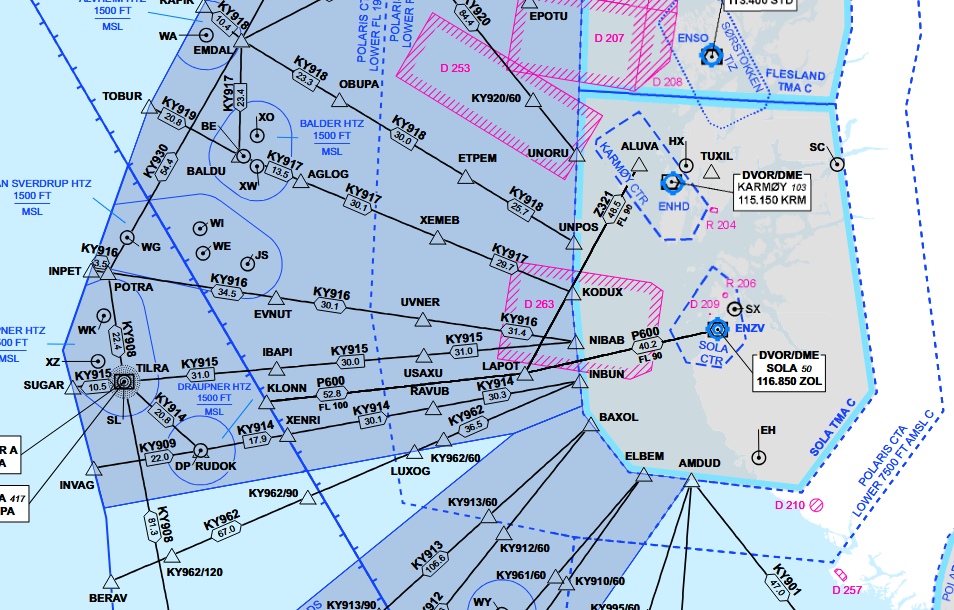
Helicopter Routes (HR) are established in that part of the North Sea and Norwegian Sea where Norway is responsible for providing ATS (REF AIP Norway GEN 3.3).
A HR is an ATS-route frequently used by civil helicopters, along which control and flight information service may be provided. They can be directional or bi-directional.
Civil helicopters are normally operating within 4 NM either side of the HR from 1000 FT AMSL to FL 80.
The HR (KY tracks) shall be utilizied outside surveillance coverage. Within surveillance-coverage, flights may be routed on direct track by ATS.
Example of helicopter routes in South Norway
Cruising below a CTA
Flights planned at 1000 FT shall follow a HR. If the flight is planning to follow a bidirectional HR (e.g KY916), this procedure shall be used:
| Magnetic track | Altitude |
|---|---|
| 360 ̊ - 179 ̊ | 1000FT |
| 180 ̊ - 359 ̊ | 2000FT or above* |
*If the flight will be provided with surveillance service, and there is no conflicting opposite traffic on the HR, 1000FT might be requested. If there is conflicting traffic at 1000FT, the flight has to be conducted within the CTA, and a request for clearance at 2000FT or above is required.
Altimeter setting
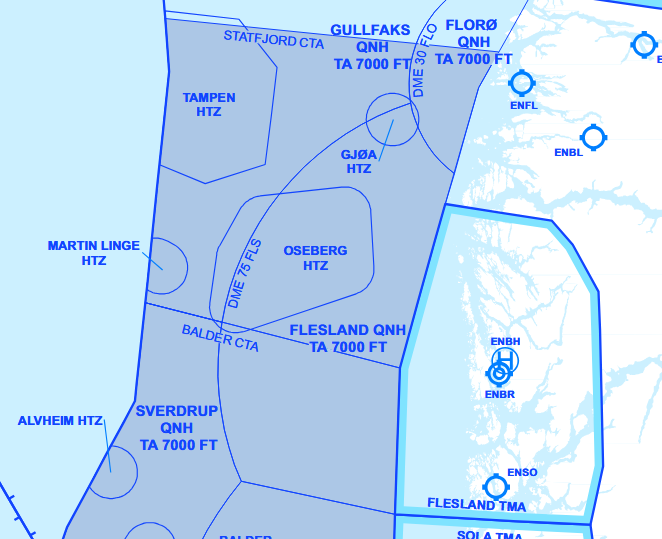
Within Polaris FIR south of 66.20 ̊N, altimeter setting at 7000 FT or lower is based on actual area QNH.
- ATS will provide QNH for the QNH Areas.
- A change to a new QNH shall be carried out when instructed by ATS.
- Transition Level for a CTA will be determined based on the lowest observed area QNH inside the CTA.
- Transiton Altitude is 7000FT
Example of QNH Areas in Southwest Norway
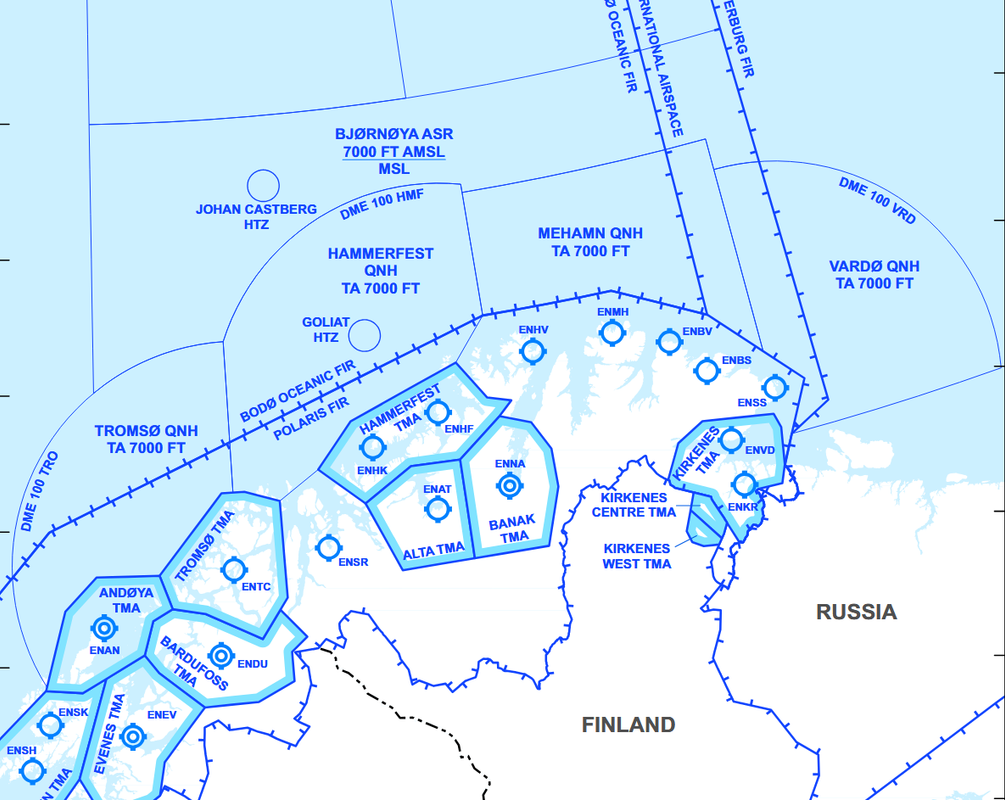
Within Polaris FIR north of 66.20 ̊N, altimeter setting is based on Forecasted Minimum QNH within Altimeter Setting Regions (ASR) Bjørnøya and Tromsøflaket.
- An estimate of the lowest QNH value for a longer period will be made for the Altimeter Setting Region and is available from ATS provider or MET office.
Example of QNH Areas and Altimiter Setting Regions in North Norway
ADS areas
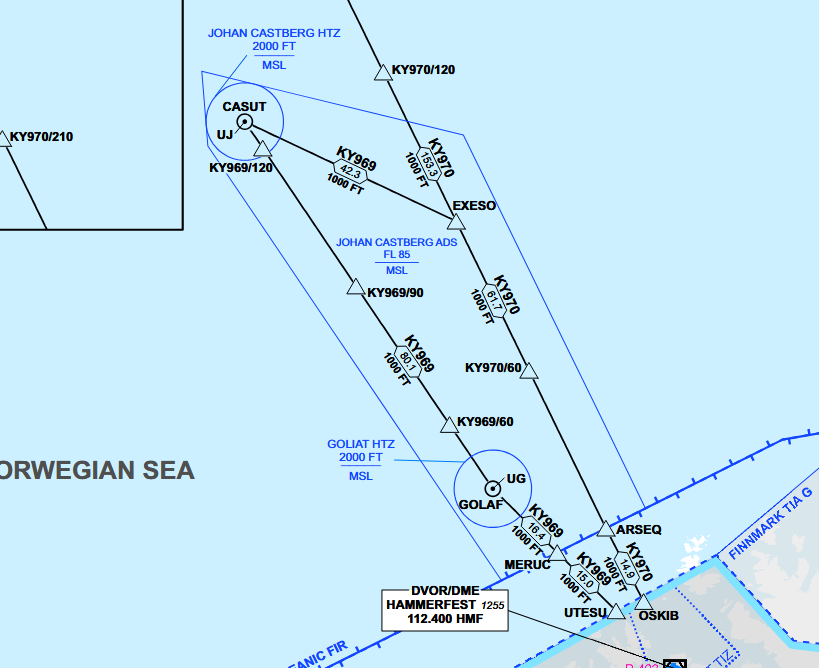
ADS areas are defined areas of Class G airspace, either below a CTA (MSL – 1500 FT), or a specific area (MSL – FL 085) between the main land bases and the main oilfields where radar- and/or ADS-based ATS is provided to participating helicopters.
Example of ADS Area without CTA
Control Areas (CTA)
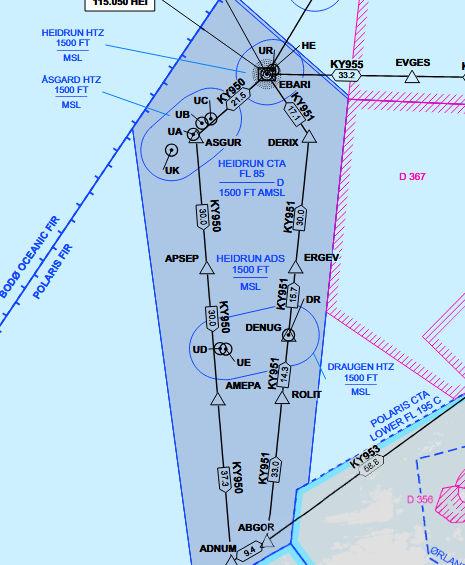
Defined Control Areas are established on the Norwegian continental shelf with Class-D Airspace, from 1500 FT- FL085. Heidrun CTA is established in the Norwegian Sea. Statfjord CTA, Balder CTA and Ekofisk CTA are established in the North Sea.
Example of CTA with ADS Area below
Helicopter Traffic Zones (HTZ)
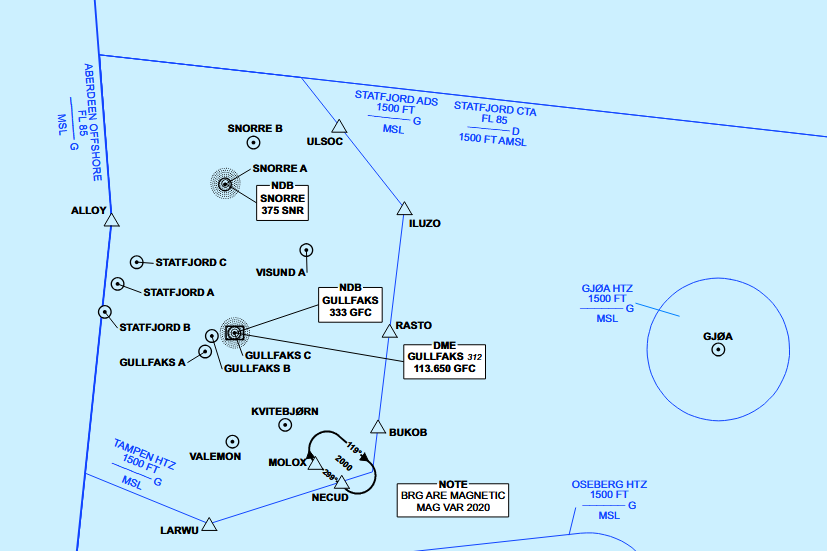
A HTZ is established at all permanent offshore installations on the Norwegian continental shelf within a radius of 7 NM from the landing pad and comprises the airspace between MSL and 2000 FT, or to the lower limit of a CTA. Around groups of two or more installations, and with distance of less than 10 NM from each other, a common HTZ is established with the border tangential to a 7 NM radius from the landing pads.
Helicopter Traffic Zones are Radio Mandatory Zones (RMZ) and two-way radio contact must be established with the approriate ATS-facility before entry.
Example of Tampen HTZ
Helicopter procedures
Onshore
IFR Procedures
VFR Procedures
Offshore
VFR Minimums
When using a offshore location as a destination or alternate, during the period between 1 hour before and 1 hour after expected time of arrival, weather forecasts should indicate above the following minima:
| Day | Night | |
|---|---|---|
| Cloud base | 600 ft | 800 ft |
| Visibility | 4 km | 5km |
when flying between offshore locations located in class G airspace where the overwater sector is less than 10 NM, VFR flights may be conducted when the limits are at, or better than, the following:
| Day | Night | |
|---|---|---|
| Height* | 300 ft | 500 ft |
| Visibility | 3 km | 5km |
*The cloud base shall allow flight at the specified height to be below and clear of cloud.
Offshore Enroute Let-down
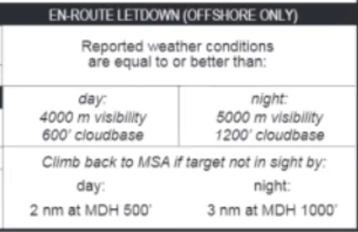
The offshore enroute let-down procedure is a general means to transition from IMC to VMC during the enroute environment. According to minimum reported weather conditions, decent below offshore MSA (1500ft) can be commenced to given thresholds, followed by a visual approach or climb back to MSA.
Offshore Standard Approach Procedure (OSAP)
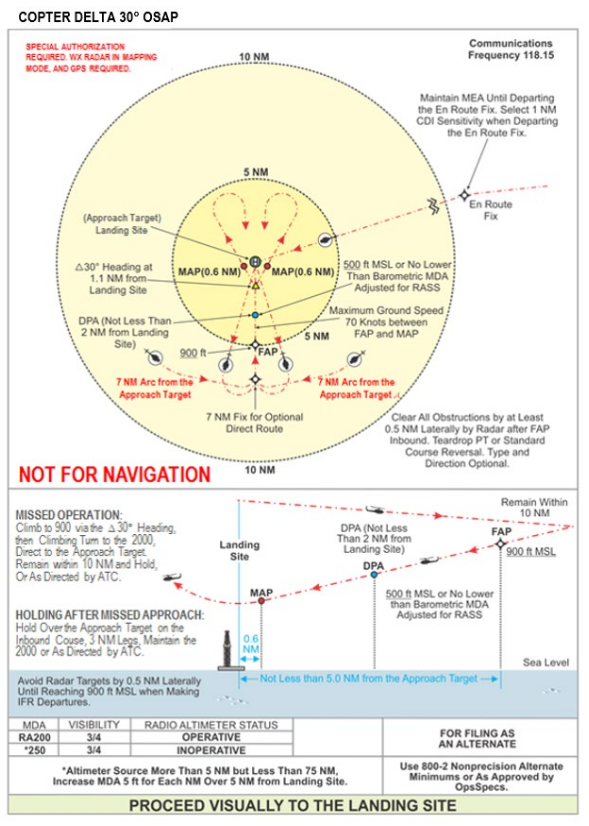
OSAPs are operator specific approach procedures designed for select offshore locations, and aided with GPS/SBAS. There are multiple designs based on the visual segment.
Sample Delta 30° OSAP
Airborne Radar Approach (ARA)
Communication
Air Traffic Service
Air traffic service provided for helicopter operations on the Norwegian continental shelf:
Southern Norway
| Area | Service | Provided by |
|---|---|---|
| Statfjord CTA | Air Traffic Control | Polaris ACC Stavanger |
| Balder CTA | ||
| Ekofisk CTA | ||
| Statfjord ADS | Flight Information | |
| Balder ADS | ||
| Balder ADS | ||
| Tampen HTZ | Tampen HFIS | |
| Ekofisk HTZ | Ekofisk HFIS | |
| HTZ | Polaris ACC Stavanger |
Middle and Northern Norway
| Area | Service | Provided by |
|---|---|---|
| Heidrun CTA | Air Traffic Control | Polaris ACC Bodø |
| Heidrun ADS | Flight Information | |
| Norne ADS | ||
| Barents Sea | ||
| HTZ |
Radio communication
On-deck report
After landing on an installation, pilots shall deliver an on-deck report to the appropriate ATS unit, and shall contain:
- Callsign
- Name on the installation
- Actual time of arrival (ATA)
- Additional information if required (e.g. refueling, shut down)
NOR123, on deck, Gullfaks C at 50
NOR123, on deck, Gullfaks C at 1450, shutting down
Pre-lift-off report
Prior to lift-off from any installation, pilots shall deliver a pre-lift-off report to the appropriate ATS unit, and shall contain:
- Callsign
- Location
- Intended route
- Intended altitude or level
The appropriate ATS unit shall provide traffic information before lift-off is initiated.
NOR123, ready for lift, Gullfaks C to Flesland, via flight planned route, 3000ft
NOR123, ready for lift, Gullfaks C to Martin Linge via NEBAV direct NASET, 2000ft
Airborne report
If not covered by other procedures, after take-off from an offshore installation, pilots shall deliver an airborne report to the appropriate ATS unit as soon as practicable, and shall contain:
- Callsign
- Actual time of departure (ATD) from installation
- Actual/intended altitude or level
- If routing via HR and no surveillance service is provided: ETO next reporting point and entry point TMA/TIZ.
NOR123, airborne Gullfaks C at 55, passing 600, climbing 1500
NOR123, airborne Ekofisk L at 31, passing 700, climbing 1000, estimate AGUVI at 36, ELBEM at 1820
Operations within a HFIS HTZ
Standard calls while operating within a HFIS HTZ:
- Pre-lift-off report
- Airborne report
- On deck report
During marginal weather conditions, additional information to the standard calls above shall be made when applicable:
- Departure heading and altitude
- Intentions
- ARA
ARA
If planning an Airborne Radar Approach, pilots shall inform the appropriate ATS unit of the following information:
- ARA to (destination)
- Final inbound course
- Course in case of Missed Approach
- Will call passing IP
NOR123, intentions to do an A R A to Ula, inbound course 040, missed approach left turn on course 355, will call passing I P
Enroute and approach to an oil field
Outbound traffic from landbase to offshore destination, shall give an estimate for an entry point (HTZ) or destination rig on the initial call to ACC.
On initial contact for flights inbound to an oilfield, the initial call or position report shall contain:
- Callsign
- ATIS Information letter (if available)
- Position
- Altitude
- Estimate time over (ETO) point of entry
- Intentions: Visual approach direct to (destination) / Cloud break, direct to (destination) / ARA
- ETA destination
Polaris control, NOR123, with Gullfaks information A, inbound NECUD, 2000ft, estimate NECUD at 40, intentions to do a visual approach direct to Kvitebjørn, estimate Kvitebjørn at 50
Shuttle (inter-rig flights)
For shuttle flights between adjacent rigs, the Pre-lift-off report and Airborne report are combined into a simplified Liftoff report that shall contain:
- Callsign
- Departure installation
- Destination
- POB
When landed, pilots shall report on deck and omit the time.
NOR123, lifting, Troll C to Troll B, 5 POB
NOR123, on deck, Troll B
Position reporting
A Position Report shall contain:
- Call Sign
- Position and Time
- Altitude
- ETO next Reporting Point
- Next Reporting Point if it is a special point
In areas with HR: a HR must be followed, and position reports shall be transmitted at each reporting point.
- Helicopter routes are identified by the letter KY (called «Copter”) and route number, e.g. KY915.
- Reporting points are identified by:
- a 5 letters identification (e.g. NECUD), or
- letters KY + route number + distance from an onshore DME (e.g KY915/90).
- Phraseology to be used is ”route number + distance” (e.g. ”Copter Niner One Five – Niner zero”)
NOR123, passing Copter 915 – 60 at 01, 2000ft, estimate 90 at 31
NOR123, passing Copter 915 – 90 at 15, 2000ft, estimate 120 at 30, SUGAR next
In areas without HR: FPL-route must be followed, and position reports shall be transmitted every 30NM.
NOR123 is position 72 north 15 east at 1002, 2000ft, estimating 73 north, 15 east at 1016