
Oceanic Area Control
The Reykjavik CTA is unique in that much of it is also designated as oceanic airspace. This page outlines the specific rules and procedures relevant to oceanic airspace.
As of 19th March 2026 aircraft entering the Reykjavik ACC no longer require an RCL as per Nat Doc 007 Chapter 6 section 6.3.24
Oceanic Airspace
Within the Reykjavik CTA, all controlled airspace outside of the Icelandic Domestic Area is considered oceanic airspace. This airspace is designated the Reykjavik Oceanic Area (OCA).
Because the Reykjavik ACC (Area Control Centre) is responsible for the Reykjavik OCA, it is also referred to as the Reykjavik OAC (Oceanic Area Control Centre.) The terms "Reykjavik ACC" and "Reykjavik OAC" are generally interchangeable for VATSIM purposes.
The Reykjavik OCA is one of six oceanic areas that make up the North Atlantic (NAT) oceanic airspace, together with Gander, Shanwick, New York, Santa Maria, and Bodo OFIR (Oceanic FIR).
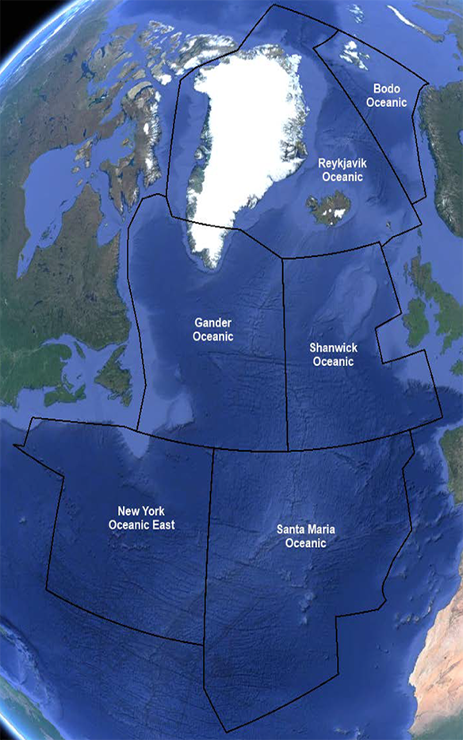
VFR is prohibited in oceanic airspace (which is all Class A.) VFR aircraft must either fly below controlled airspace, or request IFR clearance to transit oceanic airspace.
NAT Tracks
The North Atlantic oceanic airspace uses a system of tracks called the North Atlantic Organised Track System (NAT OTS,) to regulate traffic crossing the ocean. While usually remaining in Shanwick & Gander OCAs, the tracks do occasionally enter the Reykjavik OCA.
For an introduction to the NAT OTS, read this guide published by Gander Oceanic on VATSIM. (Ignore the sections on the Tango routes & Concorde tracks, as they are not relevant to BIRD OCA.)
Entering Oceanic Airspace
When entering the Reykjavik ACC an aircraft will be identified by the controller and may request a Mach number for future planning
🧑✈️ Reykavik Control ICE123 with you FL380
🎧 ICE123, Idenfied say Mach number
🧑✈️ Mach decimal 83 ICE123
🎧 ICE123, roger
The controller will either then increase their mach number or decrease, depending on traffic flow within the sector, essentially if it's a group of aircraft going into Keflavik
Entering/Exiting Other NAT OCAs
Aircraft entering BIRD OCA from other NAT OCAs (e.g., Gander, Shanwick, etc.) do not have to submit another RCL message to BIRD. However, aircraft leaving BIRD OCA to another OCA will need to submit an RCL.
Within Oceanic Airspace
CPDLC
Within the Reykjavik ACC, airborne traffic can utilise CPDLC as a form of communication as per the eaip for Iceland section 3.4 Communication services
The logon code is BIRD
We do not offer PDC or DCL clearances within the Faxi TMA. This also includes the Faroe Islands and Greenland
Cost Index (ECON) Operations
In oceanic airspace, aircraft may fly in Cost Index (ECON) mode for optimal fuel efficiency – i.e., they may deviate by up to ±0.02 Mach from the Mach number originally submitted in their flight plan, without prior permission (e.g., if they submitted Mach 0.78, they may fly between Mach 0.76-Mach 0.80 without notifying ATC.)
If they deviate by >0.02 Mach from the originally reported Mach number, they must notify ATC.
Controllers may still instruct aircraft to fly a fixed Mach number if required for separation.
A similar procedure was previously known as "Operation Without Assigned Fixed Speed" (OWAFS.) The difference is that now, pilots are expected to fly ECON mode by default, not just when ATC instructs "resume normal speed."
Strategic Lateral Offset Procedures (SLOP)
Traffic in BIRD OCA above FL285 may use SLOP (Strategic Lateral Offset Procedures). This is a random offset right of the aircraft's track, intended to "artificially" induce a navigation error that reduces the likelihood two aircraft will occupy the same airspace at once.
At the pilot's discretion, aircraft with the capability to offset (using their FMS) may offset right of track (left offsets are prohibited) up to a maximum of 2 NM (the exact offset the pilot chooses should be random) ATC does not need to approve SLOP, or be informed when SLOP is in use.
Aircraft shall not apply SLOP below FL285 in the Reykjavik OCA, and shall end the use of SLOP before entering domestic airspace.