
EFHK pilot briefing

Helsinki Airport is the main international airport of the city of Helsinki, and the entire country. The airport is located north of Helsinki in the neighboring city of Vantaa. The airport is operated by state-owned Finavia.
The airport is by far the busiest in Finland and the fourth busiest in the Nordic countries in terms of passenger numbers. About 90% of Finland's international air traffic passes through Helsinki Airport. On average, the airport handles around 350 departures a day.
The airport is the main hub for Finnair, the flag carrier of Finland, and its subsidiary Nordic Regional Airlines.
| IATA | ICAO | Charts | NOTAMs |
|---|---|---|---|
| HEL | EFHK | ChartFox - EFHK | Bulletins: EFHK |
Sceneries and GSX Profiles
List of Sceneries & GSX Profiles: Links, Sceneries & GSX Profiles
Air Traffic Control positions
Due to the size of Helsinki airport and the increased amount of operations, there is a possibility to provide service from two tower positions, two radar positions and two arrival positions:
| Login code | Call sign | Frequency | Responsibility |
|---|---|---|---|
| EFHK_DEL | HELSINKI GROUND | 118.125 | - All en-route clearances (DCL/PDC: EFHK) - Ground movement on aprons 1S and 9 |
| EFHK_GND | HELSINKI GROUND | 121.800 | - Ground movement |
| EFHK_E_TWR | HELSINKI TOWER | 118.600 | - Primary Tower position - Runways 04R/22L and 15/33 - FATO H16/H34 |
| EFHK_W_TWR | HELSINKI TOWER | 118.850 | - Opened according to traffic demand - Runways 04L/22R |
| EFHK_E_APP | HELSINKI RADAR | 119.100 | - Primary Radar position - East sector |
| EFHK_W_APP | HELSINKI RADAR | 129.850 | - Opened according to traffic demand - West sector |
| EFHK_R_APP | HELSINKI ARRIVAL | 119.900 | - Primary arrival position - Sequencing arriving traffic below 5000 FT |
| EFHK_A_APP | HELSINKI ARRIVAL | 124.325 | - Opened only during parallel IFR approaches - Sequencing arriving traffic below 5000 FT |
Listen carefully to the frequency given when being transferred to another controller. Do not try and guess the next frequency, as TWR and APP units may be divided to smaller sectors with similar frequencies.
Ground movement responsibilities:

| EFHK_DEL 118.125 |
EFHK_GND 121.800 |
EFHK_E_TWR 118.600 |
EFHK_W_TWR 118.850 |
DE-ICING |
Currently available stands
Stand allocation
Fun fact! Most of the stand numbers starts with the apron number.
| Type | Stand location |
|---|---|
| Schengen | stands 12-32 and remote stands |
| Non-Schengen | stands W34-W48, S49-S55 and remote stands |
| Cargo | aprons 2, 4 and 9 |
| General Aviation / VIP | apron 3 |
| Stands reserved for de-icing during winter season | aprons 6 and 8 |
Preferential runway system
When ATC is online, the runway is selected according to the following wind limits when possible. Note that runways may differ from real life due different traffic amount and type. Controllers on VATSIM will select the most suitable runway according to the traffic needs on VATSIM.
| Preference order: | 1 | 2 | 3 | 4 | 5 | 6 |
|---|---|---|---|---|---|---|
| Arrival runway: | 15 | 22L | 04L | 04R | 22R | 33 |
| Departure runway: | 22R | 22L | 04R | 33 | 04L | 15 |
As a general rule, the first available preferential runway will be used until the crosswind component on a dry runway exceeds 20 KT and/or the tailwind component exceeds 5 KT. If the runway is contaminated, the respective restrictions are 15 KT and 5 KT.
Mandatory departure routes
Pilots are requested NOT to include SID in their flight plan as this will be assigned by ATC.
IFR-flights departing from Helsinki above FL 95 shall use these mandatory routes after the SID.
Map of connecting routes
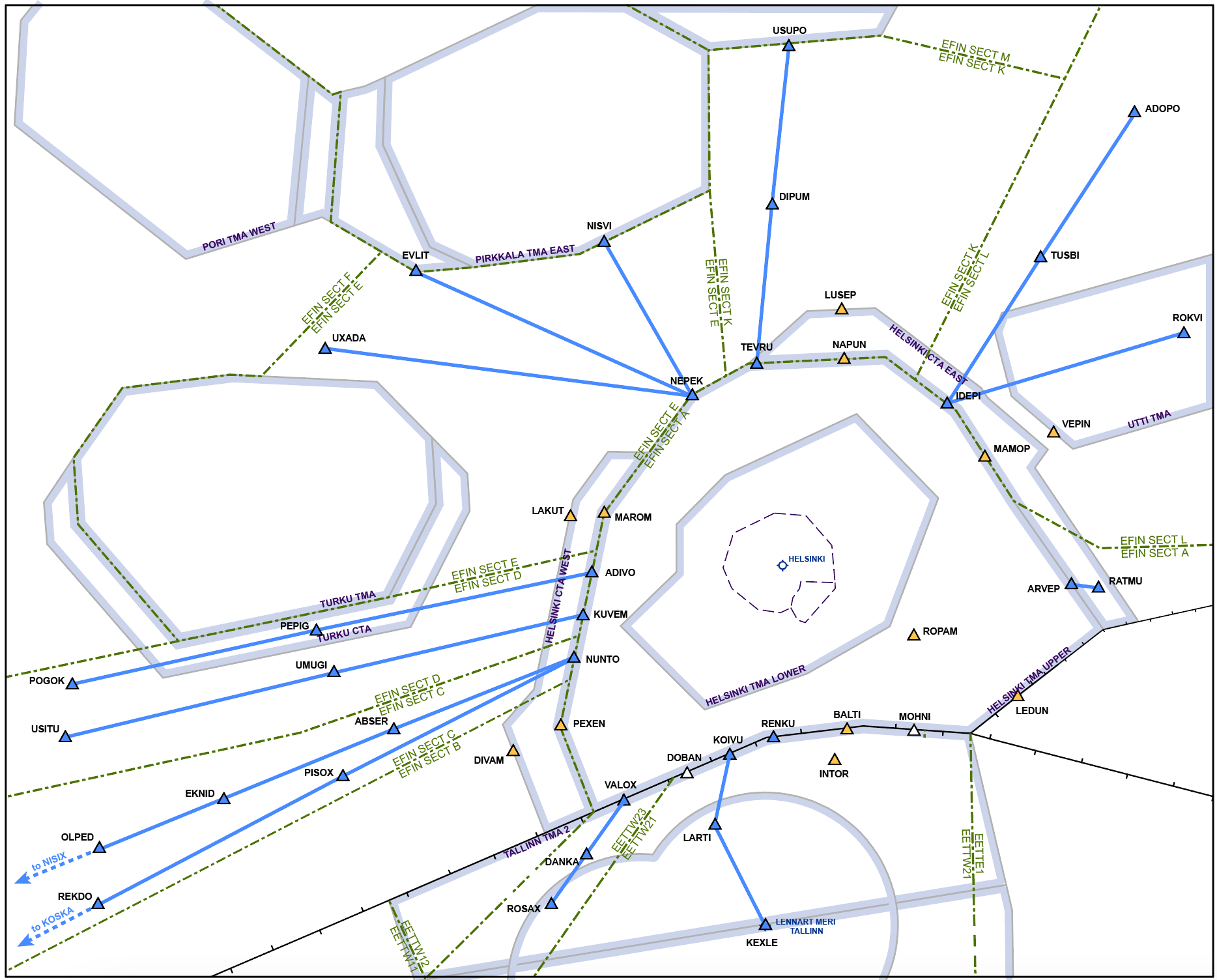
Table of connecting routes
| EFHK TMA Boundary Point | EFHK DEP Connecting Point | Flight Plan |
|---|---|---|
| NUNTO | KOSKA | NUNTO-Y369-REKDO-DCT-KOSKA-DCT |
| NUNTO | NISIX | NUNTO-Y367-OLPED-DCT-OBEVI-NISIX-DCT |
| KUVEM | USITU | KUVEM-Y366-USITU-DCT |
| ADIVO | POGOK | ADIVO-Y365-POGOK-DCT |
| NEPEK | NISVI | NEPEK-Y361-NISVI-DCT |
| TEVRU | USUPO | TEVRU-Y75-USUPO-DCT |
| IDEPI | ADOPO | IDEPI-Y232-ADOPO-DCT |
| IDEPI | ROKVI | IDEPI DCT ROKVI DCT |
| ARVEP | RATMU | ARVEP-T82-RATMU-DCT |
| NEPEK | EVLIT | NEPEK-Y357-EVLIT-DCT |
| NEPEK | UXADA | NEPEK-Y375-UXADA-DCT |
| VALOX | no mandatory route | |
| KOIVU | no mandatory route | |
| KOIVU | no mandatory route |
Additional restrictions
| (Destination) | Route | Remarks / Restrictions |
|---|---|---|
| EETN | RENKU | RENKU IS ONLY AVBL FOR TFC ARR EETN. NOT AVBL ABV FL115. |
| EFTU | ADIVO DCT EXUPA | Exception to EFHK connecting routes. |
| EFMA | ADIVO Y365 PEPIG DCT EBEBU | Exception to EFHK connecting routes. |
| EFUT | IDEPI DCT VEHUF | Exception to EFHK connecting routes. |
| VALOX | In order to avoid re-entry to Helsinki FIR, traffic via VALOX shall file VALOX Y117 ROSAX DCT NEBSI. |
After the last point of the mandatory departure route, pilots have mostly free hands to plan their flights with DCT routes.
RENKU is only available and mandatory for departures to EETN or EEEI. Maximum cruise level is FL 100.
En-route clearance
En-route clearance can be requested with DCL (datalink) or with VOICE over the ground or tower frequency depending on which ATC position is online.
If using DCL, pilots shall send the pre-dep request to identifier EFHK or EFIN, depending on which station is online. Frequency 118.125 shall be monitored when requesting clearance via DCL.
On initial contact, state aircraft type, received ATIS and QNH.
| 👨✈️ | FASTAIR 312, AIRBUS 320, INFORMATION M, QNH 1011, REQUEST CLEARANCE TO OULU |
Departure with SID:
| 🎧 | FASTAIR 312, CLEARED TO OULU, RUNWAY 22R, TEVRU 3N DEPARTURE, CLIMB VIA SID TO 4000 FEET, SQUAWK 5542 |
Departure with heading:
| 🎧 | FASTAIR 312, CLEARED TO OULU, RUNWAY 22R, AFTER DEPARTURE FLY HEADING 270, CLIMB TO 4000 FEET, EXPECT RADAR VECTORS TO TEVRU, SQUAWK 5542. |
If you prefer to use a different runway due performance, you may ask it prior to receiving the en-route clearance. Runways 22L and 15 are often approved for turboprop or quiet aircraft.
If unable to follow RNAV SID, inform ATC when requesting clearance.
| 👨✈️ | FASTAIR 312, AIRBUS 320, INFORMATION M, QNH 1011, REQUEST CLEARANCE TO OULU, NEGATIVE RNAV |
Your en-route clearance will include the destination, departure runway, SID or heading and the initial climb which is usually 4000 feet. You will also receive an SSR-code which shall be selected and activated prior to taxi.
Take-off and climb
When cleared for take-off, pilots are expected to start rolling within 10 seconds of take-off clearance. Pilots unable to comply with this requirement shall notify ATC before entering the runway.
Radio transfer procedures
After take-off aircraft shall remain on tower frequency until passing 1500 FT, then contact Helsinki Radar 119.100 or 129.850, depending on your SID route.
You will find the correct radar frequency on your SID-chart. If the primary frequency is not online, contact Radar on the other frequency or Helsinki Control on 121.300.
Pilots shall automatically change to radar frequency after departure!
Initial contact with Radar after departure
When contacting Helsinki Radar, state your altitude and assigned SID. If you are assigned a heading, report the heading to Radar on initial contact.
| 👨✈️ | HELSINKI RADAR, FASTAIR 312, PASSING 1900 FEET, TEVRU 3N |
If no further climb is given, pilot shall maintain 4000 FT.
Mandatory arrival routes
Pilots are requested to not include STAR in their flight plan route.
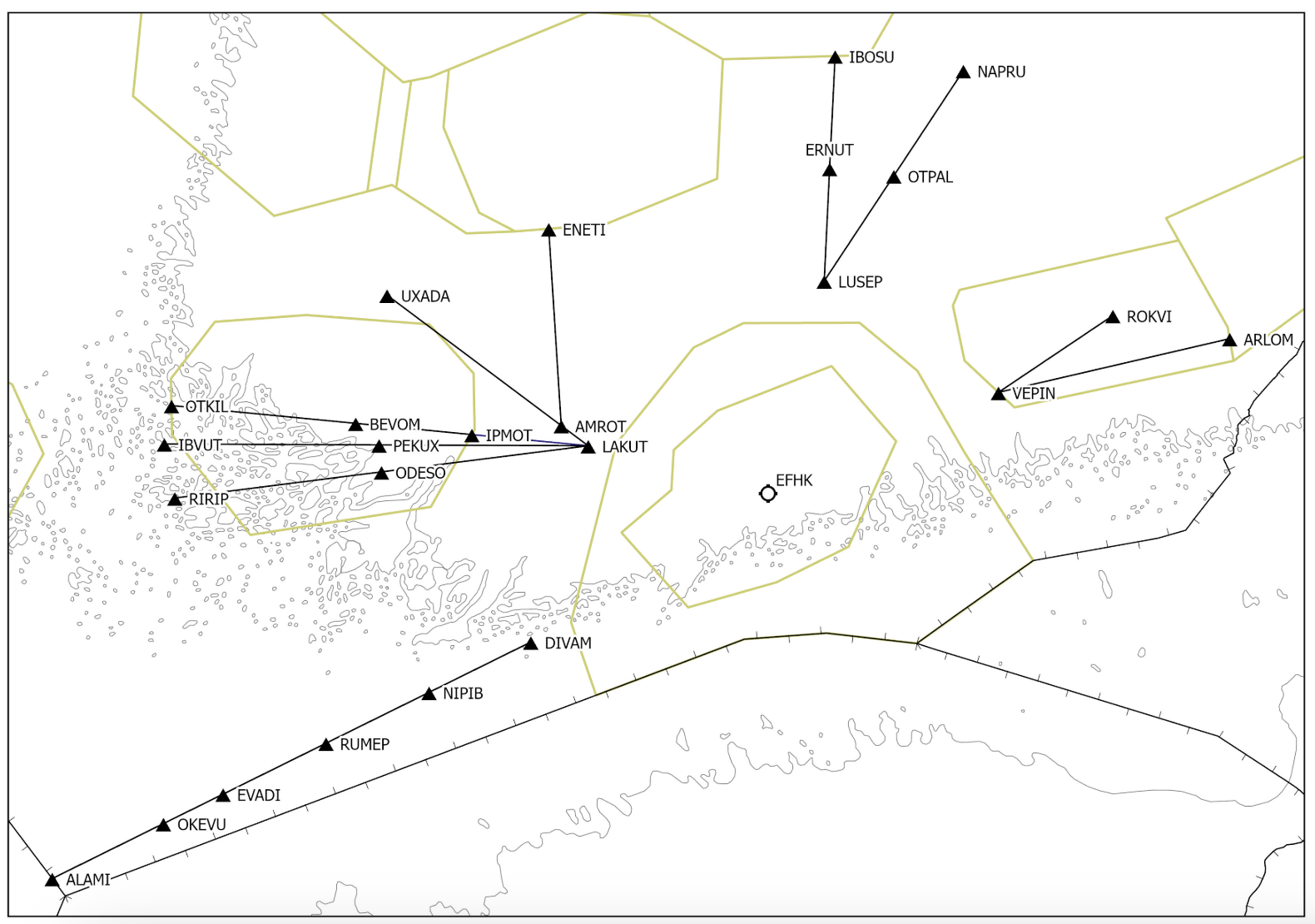
Arriving traffic to EFHK above FL 95 should be filed via the following routes:
aircraft below FL 95 are allowed to file flight plan direct to TMA Boundary Point.
| EFHK Arrival Connecting Point | EFHK STAR Initial Waypoint | Flight Plan |
|---|---|---|
| ALAMI | DIVAM | DCT to ALAMI-OKEVU-EVADI-Y370-DIVAM |
| RIRIP | LAKUT | DCT to RIRIP-Y364-LAKUT |
| IBVUT | LAKUT | DCT to IBVUT-Y363-LAKUT |
| OTKIL | LAKUT | DCT to OTKIL-Y368-LAKUT |
| UXADA | AMROT | DCT to UXADA-Y349-AMROT-Y362-LAKUT |
| ENETI | LAKUT | DCT to ENETI-Y362-LAKUT |
| IBOSU | LUSEP | DCT to IBOSU-Y86-LUSEP |
| NAPRU | LUSEP | DCT to NAPRU-T83-LUSEP |
| ROKVI | VEPIN | DCT to ROKVI-Y358-VEPIN |
| ARLOM | VEPIN | DCT to ARLOM-Y359-VEPIN |
Radio procedures for arrivals
Arriving traffic is informed of the runway in use and cleared for the appropriate STAR serving the arrival runway. This information is given by Area Control (EFIN/EETT) when online.
Initial contact with Helsinki Radar
| Call sign | HELSINKI RADAR, FINNAIR 6 |
|---|---|
| Aircraft type | AIRBUS 330 |
| “HEAVY” or “SUPER” if necessary | HEAVY |
| Current flight level | FLIGHT LEVEL 154 |
| Speed (only if assigned by ATC) | SPEED 240 KNOTS |
| Last received ATIS broadcast | INFORMATION SIERRA |
Initial contact with Helsinki Arrival
Say your Call sign only on initial contact with Helsinki Arrival
| Call sign | HELSINKI ARRIVAL, FINNAIR 6 |
|---|
Initial contact with Helsinki Tower
| Call sign | HELSINKI TOWER, FINNAIR 6 |
|---|---|
| Runway | RUNWAY 22 LEFT |
Clearance for Approach
There are 2 ways to be cleared for the approach:
All STARs at Helsinki are so-called Open STARs. If ATC has not given approach clearance, the pilot shall continue present heading after the last waypoint on the STAR:

When aircraft is cleared for approach via own navigation, pilot shall plan a direct (DCT) instead of a vector after the last waypoint on the STAR.
| 🎧 | SPEEDBIRD 794H, VIA KENON BIFIX CLEARED ILS APPROACH RUNWAY 22 LEFT |
Visual approach
ILS is the primary approach type. Upon pilot request, ATC may give clearance for a visual approach.
ATC may advise to “maintain own separation from preceding”, if there are other aircraft approaching the airport. In that case, the separation responsibility will transfer from ATC to the pilot performing the visual approach.
| 🎧 | SPEEDBIRD 794H, DESCEND 2000 FEET, CLEARED VISUAL APPROACH RUNWAY 15, RIGHT CIRCUIT, QNH 1011, MAINTAIN OWN SEPARATION WITH PRECEDING AIRBUS 330 HEAVY, CAUTION WAKE TURBULENCE |
Aircraft on visual approach shall maintain at least 2000 FT until established on final approach course. ATC may give permission “you may leave 2000 feet before final”.
Simultaneous IFR approaches
During periods of heavy inbound traffic, dependent or independent simultaneous approaches may be used on runways 04L/R or 22L/R.
- Pilots are informed when parallel approaches are in force via ATIS:
- "SIMULTANEOUS DEPENDENT/INDEPENDENT IFR APPROACHES IN PROGRESS"
Area control will inform the landing runway as early as possible; however, pilots should plan on landing on either runway when parallel approaches are in progress.