
General Briefing
Introduction

Illustration by Isavia.
The Reykjavik Control Area (BIRD CTA) covers over 5.4 million square kilometres of oceanic airspace between North America and Europe, stretching all the way to the North Pole. Under this airspace lie three territories: Iceland, Greenland and the Faroe Islands, each with unique geography, airports, and airspace. Together, they offer the VATSIM pilot limitless opportunities for flying.
Our closest neighbors are Norway, Canada, and Scotland. Neighboring FIRs and oceanic areas include Murmansk (ULMM), Bodo Oceanic (ENOB), Polaris (ENOR/ENSV), Scottish (EGPX/SCO), Shanwick (EGGX), Gander (domestic & oceanic; CZQX/CZQO), and Edmonton (CZEG.)
Sectors
The BIRD CTA is split into four sectors: North, South, East, and West.
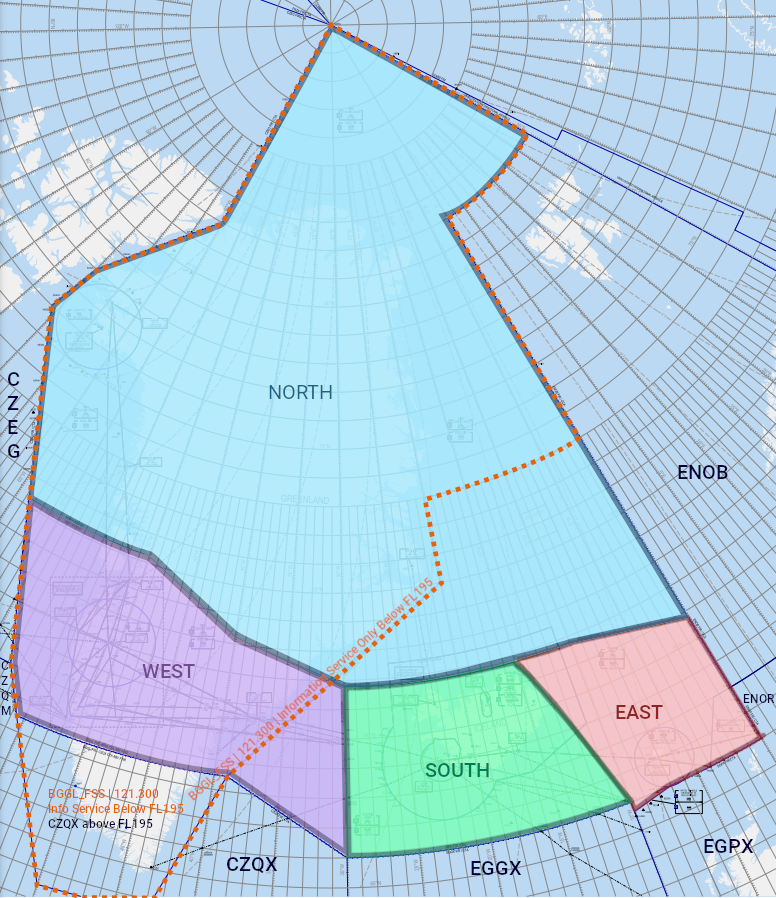
The most commonly staffed Reykjavik Control position is BIRD_S1_CTR (frequency 119.700.) This position, when online by itself, covers the West, South, and East sectors, and provides top-down coverage for all of Iceland (BI** airports), EKVG (& surrounding airspace of the Faroe Islands), and BGSF (& surrounding airspace over parts of central Greenland.)
There are, of course, various other BIRD positions available to be opened, where multiple controllers split the various BIRD sectors between them. When multiple BIRD positions are open, you may check vatglasses.uk to see which controller is controlling what airspace, or wait for a “contact me” message from the controller.
NOTE: Sometimes, during major events like Cross the Pond, the division of airspace between controllers may be changed from what it usually is, to accommodate the specific needs of that event. This may cause Vatglasses to be inaccurate. If you receive a “contact me” message from a BIRD controller, even if Vatglasses says you’re not in their airspace, do what the controller says.
The North sector is controlled exclusively by Iceland Radio (BICC_x_FSS.) Iceland Radio is a unique position on VATSIM that provides a variety of air traffic services, including:
- ATC in the North sector.
- IFR clearances for departures on the ground at Greenlandic uncontrolled airports (usually relayed by local AFIS, but if no local AFIS is online, then pilots may contact BICC directly.)
- (If BGGL_FSS/Nuuk Information is offline and workload permits) Flight information service in Nuuk FIR below FL195, including top-down ATC at BGSF (Kangerlussuaq) if no local BGSF ATC is online.
If you are confused about when to talk to Iceland Radio, simply message the controller (we’re always happy to help, provided we’re not too busy!) or wait for a “contact me” message.
Oceanic Airspace
Much of the BIRD CTA — except some low-level airspace over Iceland and Greenland — is oceanic airspace, forming of the North Altantic (NAT) oceanic area. The parts of the BIRD CTA which are oceanic airspace are known as the Reykjavik Oceanic Area (BIRD OCA.)
Even though the BIRD OCA is oceanic airspace, the entirety of the BIRD CTA/OCA has either radar or ADS-B coverage within controlled airspace. Therefore, position reports are not required, and pilots can expect to receive a typical ATS surveillance service similar to any domestic ATC position, including speed control, vectors, etc.
NAT Tracks
The North Atlantic oceanic airspace uses a system of tracks called the North Atlantic Organized Track System (NAT OTS,) to regulate traffic crossing the ocean. While usually remaining in Shanwick & Gander OCAs, the tracks do occasionally enter the Reykjavik OCA.
If you want to learn more about how the NAT tracks work, read this helpful guide published by the Gander OCA on VATSIM. (Ignore the sections on the routes & Concorde tracks, as they are not relevant to the BIRD OCA.)
Entering Oceanic Airspace
As of 19th March 2026 aircraft entering the Reykjavik ACC no longer require an RCL as per Nat Doc 007 Chapter 6 section 6.3.24
All flights entering oceanic airspace must have an IFR clearance. It is not permitted to fly VFR in oceanic airspace – you must either fly below controlled airspace (generally, below FL55 over the ocean, or below FL195 over Greenland), or obtain IFR clearance.
If you are:
- Already airborne,
- Entering BIRD OCA, and
- Have not previously spoken to any other oceanic ATC (Gander, Shanwick, etc.)
Voice Phraseology
This is an example of communication between a pilot and the controller when entering the Reykjavik ACC
🧑✈️ Reykjavik Control, ICE123, FL380
🎧 ICE123, Reykjavik Control, Identifed
The controller then may ask you for your Mach number (This is pottentionally for forward planning and flow management)
🎧 ICE123, Say Mach number
🧑✈️ ICE123, Mach decimal 78
🎧 ICE123, roger, Maintain Mach decimal 78.
The controller may ask you to increase or decrease your Mach speed depending on traffic in the area or for flow management.
Within Oceanic Airspace
Cost Index (ECON) Operations
In oceanic airspace, you may now fly in Cost Index (ECON) mode for optimal fuel efficiency – you do not have to strictly adhere to a specific Mach number.
Note that controllers may still instruct you to fly a fixed Mach number if required for separation.
This procedure was previously known as "Operation Without Assigned Fixed Speed" (OWAFS) – the difference is that now (as of 20th March 2024), pilots are expected to fly ECON mode by default.
Strategic Lateral Offset Procedures (SLOP)
In BIRD OCA, above FL285, you may use SLOP (Strategic Lateral Offset Procedures). This is a random offset off your aircraft's track, intended to "artificially" induce a navigation error that reduces the likelihood two aircraft will occupy the same airspace at once.
At pilot's discretion, aircraft with the capability to offset (using their FMS) may offset right of track, up to a maximum of 2 NM (the exact offset you choose should be random.) ATC does not need to approve SLOP, or be informed when SLOP is in use. Left offsets are prohibited.
You must not apply SLOP below FL285 in the Reykjavik OCA, and must end the use of SLOP before entering domestic airspace.