
CDM Operation
CDM Procedures, What it is? How it works? How to use it? How it is intergrated into FlightStrips...
From November 5th CDM becomes mandatory in Copenhagen FIR
1. CDM OperationPrinciples
CDM - Explained
CDM (Collaborative Decision Making) is a complex but vital part of ensuring we can cope with the traffic levels on VATSIM. In order to use CDM properly it is important that you understand
- The logic behind CDM operation
- How to effectively use CDM operation
1.1 Purpose
The first thing you need to understand is that there are TWO (2) different kinds of CDM, They are intertwined and both must be respected.
- A-CDM (Airport - Collaborative Decision Making)
- vIFF CDM (Intergrated Flight and Flow - Collaborative Decision Making)
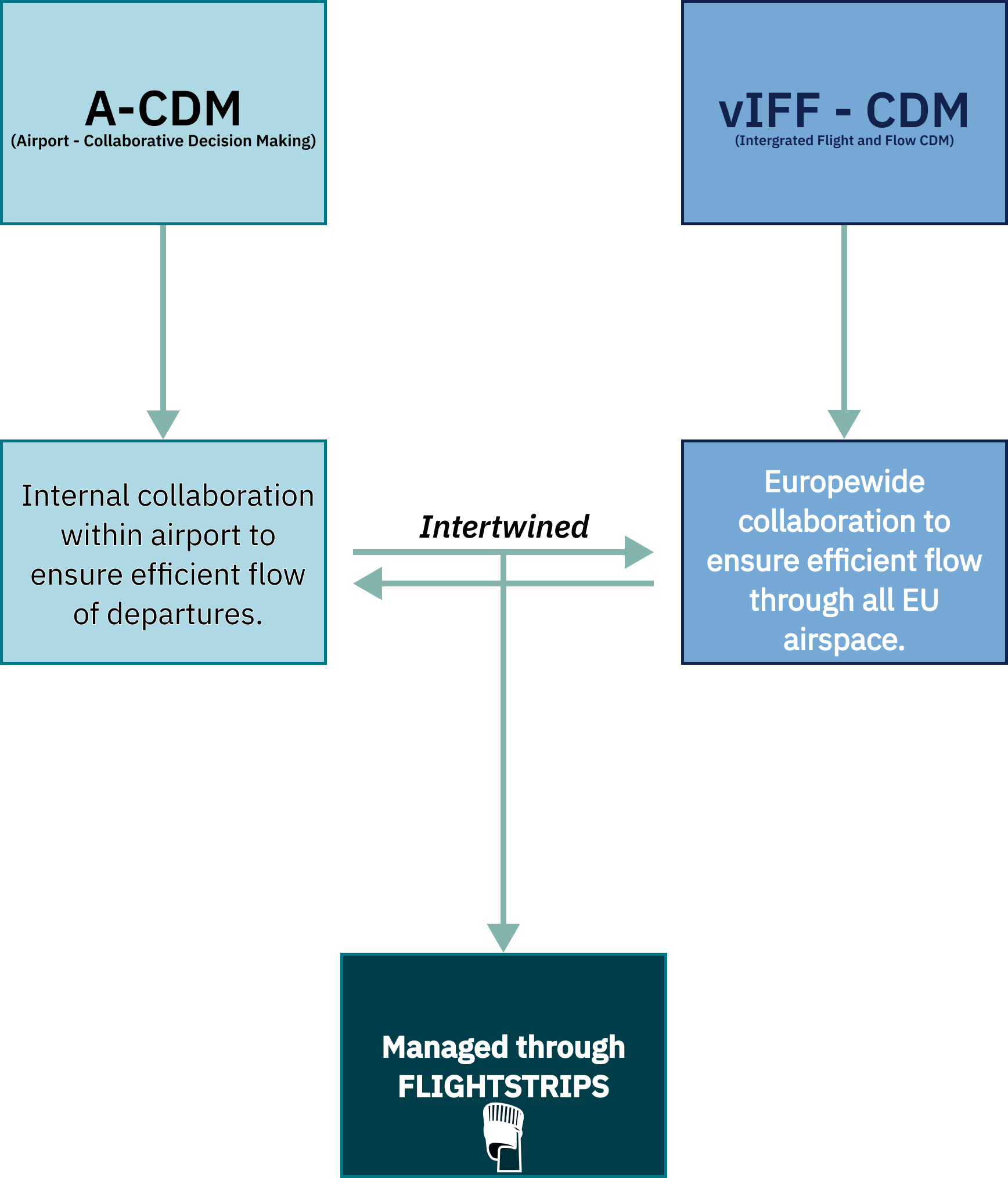
These two systems work towards seperate goals, but must constantly talk to eachother as they are codependent.co-dependent.
A change to one of the entities can affect the other one. In order to ensure compliance we have intergrated it all in a user friendly managed manner within FlightStrips
1.2 Abbriviations & Explanations
Many foreign abbreviations are being used for CDM, and we need to cut it into the bone of knowing just the basics for your daily routingrouting:
NOTE: Blue background items are operational items, gray background items are purely adminstrative and not gouvering when controlling
|
|
|
|
EOBT | Estimated Off Block Time | The time the pilot has filed his flightplan to be ready for Startup | Used as initial planning for the TOBT until system, ATC or Pilot says otherwise. |
TOBT | Target Off Block Time | Time the pilot targets to be ready for Startup, depending on the loading process and pax delays | Accepted via pilot EOBT. Can be modified by ATC, the Pilot, CTOTs or automatically by the system at any time. |
TSAT | Target Start Approval Time | Time the ATC targets to provide pilot with his startup, based on capacity restrictions at his TOBT | Based on the filed TOBT, system will calculate the closest time to the TOBT that startup can be approved to respect all flow restrictions |
CTOT | Calculated Take-Off Time | Time pilot must be “Takeoff” in order to respect a restriction en-route or at arrival field | If a vIFF restriction en-route forces aircraft to be airborne in a certain time window a CTOT will be produced to ensure this. |
ASAT | Actual Start Approval Time | Actual time of Start. | Locks the timings in vIFF |
EXOT | Estimated Taxi-Out Time | Expected time between Start and Takeoff | Standard timings based on gate |
TTOT | Target Take-Off Time | Expected Takeoff Time based on Taxi out time and TOBT. | Used to ensure an even departure rate |
1.3 Flow Control Logic
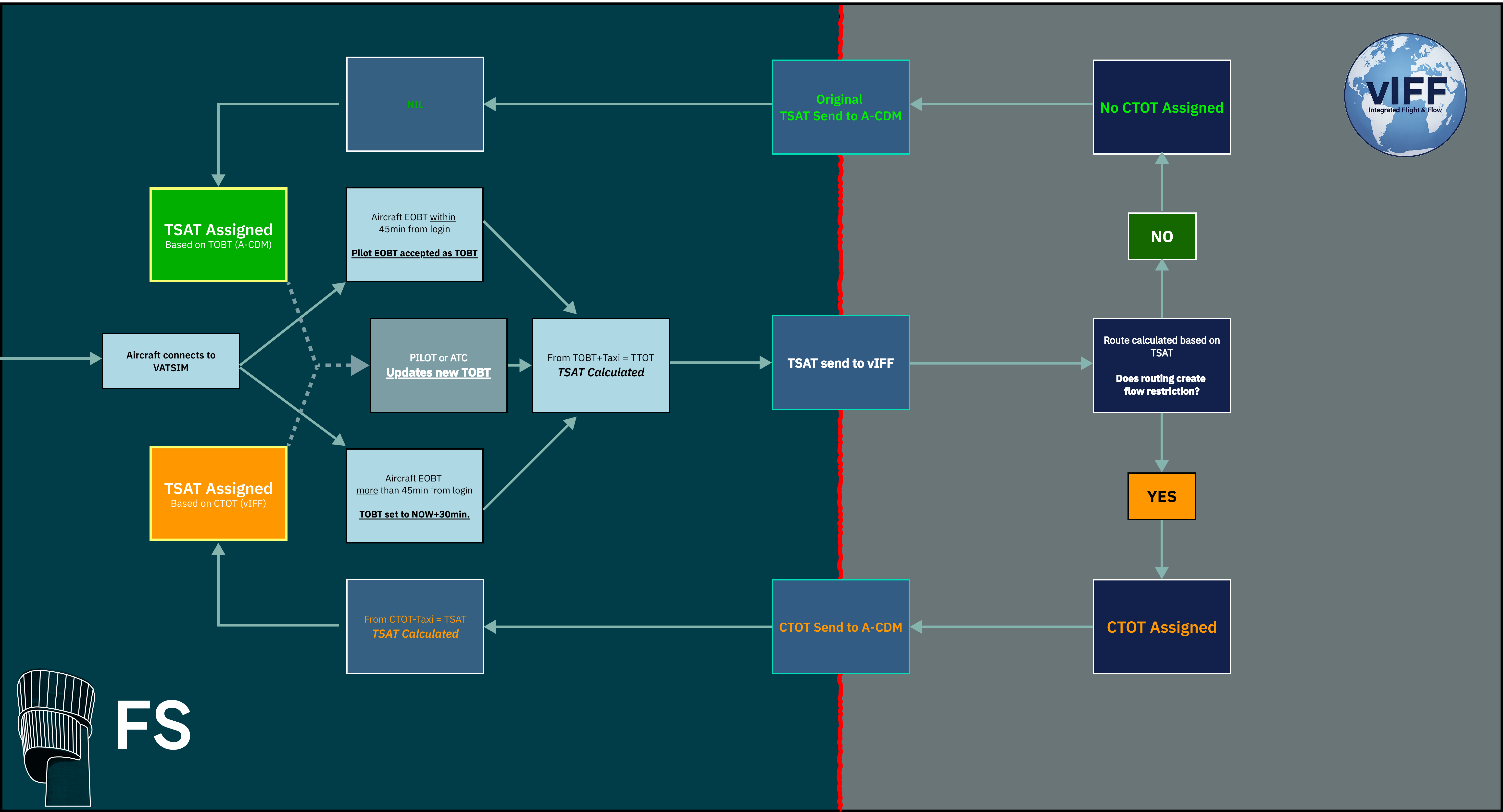
Flow Control logic works through constant calculations. It is important that you understand the logic.
- Pilot Logs onto VATSIM Network. In his Flightplan he has filed an EOBT.
- FS evaluates the validity of EOBT, and assigns a TOBT.
- A-CDM process begind. Based of the TOBT and available space in sequence a TSAT is "calculated"
- The TSAT is send to vIFF servers for calculation.
- vIFF servers used TSAT to calculate the routing to the destination, and if it exceeds ATC capacity anywhere
- One of two things happen:
- a) No restrictions are identified, and TSAT is returned without edits to A-CDM.
- b) Restrictions identified, CTOT produced to comply with restricionts and returned to A-CDM.
- A-CDM either confirms the TSAT, or calculates a new TSAT based on CTOT restriction
- TSAT is "Assigned" to an aircraft.
- If a TOBT is updated by either pilot or ATC, steps 3-8 are repeated.
Refer to flowchart below for visual explanation
1.4 2.Calculation
1.4.1 A-CDM
A-CDM Proceduresneeds to calculate a takeoff sequence. The core purpose is to only have as many departures an hour as the airport can handle, and nicely spread out. Therefore it is all based on TTOT (Target Takeoff Time).
- In EKCH the capacity is 40flts/hr and therefore we have 40TTOT spots, spaced 1.5 minutes apart.
The calculation of A-CDM is as follows:
- EOBT is recorded from flightplan, and based on that a TOBT is assigned.
- Stand is recorded and based on RWY in
FlightStripsuse, a EXOT is established. TOBT+EXOT = TTOT- Example: TOBT: 1435z. EXOT 12min; 1435z+00:12min = TTOT=1447z
- The system then compares the TTOT to available TTOTs and does one of two things:
- TTOT available: TSAT issued at TOBT
- Example: TTOT: 1447z available, EXOT 12min. 1447z-00:12min = TSAT=1435z
- TTOT occupied: Find next available TTOT, calculate back EXOT, which becomes TSAT
- Example: TTOT: 1453z first available, exit 12min. 1453z-00:12min = TSAT=1441z
- TTOT available: TSAT issued at TOBT
- TSAT assigned to optimize traffic flow depending on what TTOT is available.
1.4.1 vIFF - CDM
vIFF does NOT care about our internal capacity. Only about:
- Enroute Sector capacity
- Arrival TMA capacity
- Arrival Airport capacity
- ECFMP special restrictions
vIFF knows the EXOT of EKCH.
- TSAT which was determined by A-CDM is send to vIFF.
- vIFF, uses TSAT+EXOT to determine TTOT, and afterwards a 3D routing through all airspaces
- If a sector capacity does not allow the flight it will assign a CTOT at a time the capacity allows.
- CTOT is send back to A-CDM
- A-CDM produces a TSAT to fit that CTOT, overriding all other A-CDM restrictions, and delaying subsequent aircrafts TTOT.