
ESPA - Luleå/Kallax
Overview
Göteborg/LandvetterLuleå/Kallax is Gothenburg’sa mainjoint civil-military airport andwhich is home to the secondF busiest21 airportair inwing. Sweden.The Itcivilian is located around 25 km eastside of the city of Gothenburg. The airport opened in 1977. Landvetter has over 4 million passengers annually, and has a capacity for up to 6 million passengers.
Around 25 airlines operate at Landvetter, serving around 50 destinations with scheduled passenger flights, as well as many charter destinations. Domestic services nowadays are limited to Stockholm/Arlanda. Landvetter is also anrelatively importantbusy, cargowith terminal,several airlines serving Stockholm/Arlanda on a daily basis. There is also scheduled traffic to Gothenburg, and sinceseasonally Säveto airportZurich closedand forParis-Orly.
At operationsalmost most3.4 ofkilometres, the GArunway trafficat includingKallax businessis jets,the governmentlongest andrunway coastin guard flights also use Landvetter.Sweden.
Airport Charts
Parking stands
Available stands
Stand allocation - Who parks where
The airport website shows the real gate for each DEPARTING and ARRIVING flight.
FBOtraffic- Airline flights mainly use stand 3-5 (
Standwith1)airForbridge)smalland 20-22 (remote stands). - Cargo flights use Apron 11.
- GA on stand 7-8.
- Small GA
andonaircraftAprongoing to Cessna maintenance hangar10. Cargotraffic- APN 1: Helicopters e.g. HKP 14 (
Stand 5-10, 42-44) - All cargo airlines PassengerAPNTerminal2:- MIL
- jets e.g. JAS 39 (
Stand 12-19) - Schengen and domestic flightsSB39) - APN 3: MIL jets e.g. JAS 39 (
Stand 20-21) - Schengen and Non-Schengen flightsSB39) (StandAPN22-23)8:-TransportNon-Schengenaircraftflightse.g.
- jets e.g. JAS 39 (
Remote ParkingStand 30-41A, 46-78 - Regional Jets, Turboprops and GA.
Civil
Civil Jetaprons Centerare on the north side of the runway:
Military
Military aprons are on the south side of the runway:
IFR Clearance
AtATC firstclearance contactwill withbe Clearancedelivered Deliveryprior stateto/at standstart-up. numberSuch clearance will be issued for RWY in use and latestappropriate received ATIS transmission including identification letter and QNH.SID.
- If unable to follow FMS/RNAV SID, inform ATC when requesting clearance. Expect
toradarbe assigned a SID and to follow special instructions given in the SID charts.vectors.
SID Assignment
Unless otherwise instructed, jet aircraft cleared via SID shall climb to 5000 ft (4000 ft applies to specific prop SIDs). Check SID chart for correct altitude and ask ATC if uncertain!
Propeller departures
Between 06 and 22 local time, propeller aircraft may be cleared via radar vectoring.
Pushback
- Pushback is
normalnormallyprocedurerequired from stand and 3-8, 20 and 22. - Power out from stands 20-22 and 7-9 is permitted for aircraft
CodewithBMTOM 20 tonnes or less. - Power out from stands 22, 7 and
larger.Generally, a push-back direction8 isincludedpermitted for aircraft size RJ1H or smaller, provided the aircraft has been parked in order to allow taxiing out from theclearance,standfacingundernorthown power. - Power out from stand 20 is permitted for aircraft size A320 or
south.smaller,proviced the aircraft has been parked in order to allow taxiing out from the stand under own power (normally facing north), and that stands 21-22 are free.
Use of transponder
The assigned transponder code shall be selected and the transponder activated at the request for push-back. After landing, the transponder shall remain activated until reaching the parking stand and be switched to standby immediately after parking.
Taxi
LandingLarge transport aircraft shall,(C130, afterC17) landing,to completelyMIL vacateAPN the8 runwayshall use TWY A and holdcross positionRWY via A3, U3.
Avoid back-track on TWYRWY Ybetween untilApril taxi15 clearanceand isOctober obtained.30 due to risk of surface damage.
OverviewAPRON of9 taxi(MAIN proceduresAPRON) LIMITED (REF AIP SUP 277/25):
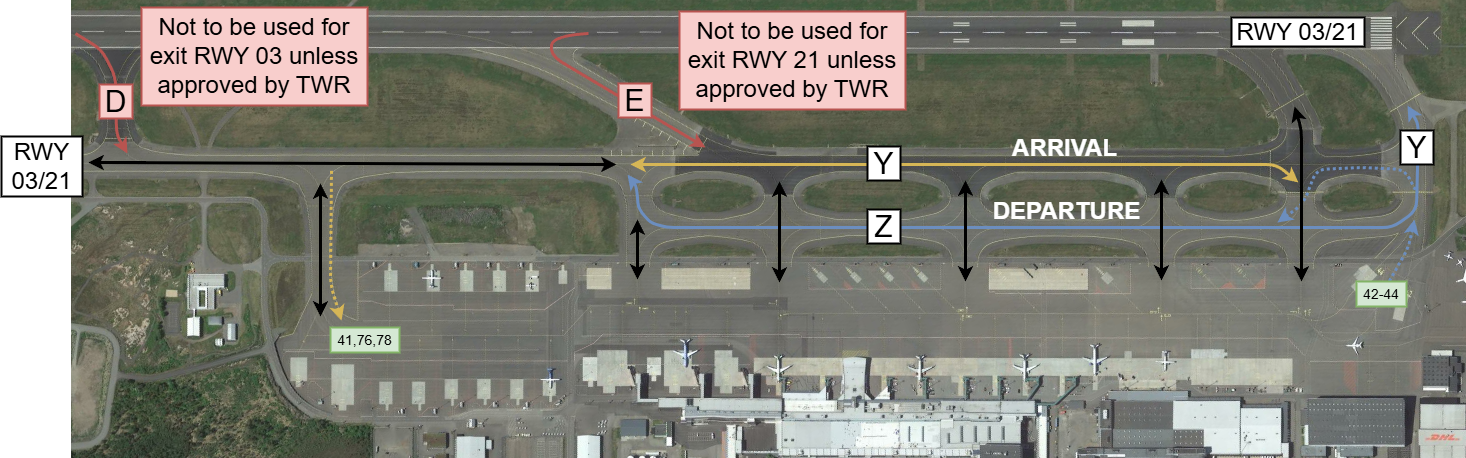
- N
instructions as shown above areentry tobeAPNexpected.9:Refermax wingspan 52 m (code D) - S entry to
ATCAPNinstruction9for(secondactualentrytaxiwaycountedrouting.from•north):TWYmaxCwingspannot65tombe(codeusedE)
Taxi
Take-off and climb
Unless otherwise instructed, aircraft cleared via SID shall climb to 5000 ft (4000 ft applies to specific prop SIDs).
Contact GöteborgKallax Approach when instructed by TWR.
On initial contact with GöteborgKallax Approach report altitude to verify transponder Mode C readout.
If unable to follow FMS/RNAV SID, inform GöteborgKallax Approach on initial contact stating “unable RNAV SID.”
RNAV STAR
Advise if unable to follow RNAV STAR. Radar vectoring will be provided.
Observe the maximum flight levels when arriving via LOBBI/MAKUR.
When cleared to a lower level or cleared for approach while on a STAR, minimum levels as published in the STAR must still be followed.
RNPMET approachesinformation
CurvedAs (RNPthere AR)is no ATIS, expect ATC to read the relevant weather information for arrival and departure.
Military traffic
Regulations
Military pilots should be familiar with Rules and Procedures for Military Aviation.
COM Channels
| Login Callsign | Radio Callsign | Frequency | MIL Channel |
|---|---|---|---|
| ESPA_APP | Kallax Approach | 125.450 | C2 |
| ESPA_F_APP | Kallax Approach | 130.800 | C |
| ESPA_P_APP | Kallax Precision | 119.000 | B |
| ESPA_TWR | Kallax Tower | 128.200 | A |
Expect the MIL channel designation to be used when getting a frequency change, for example:
CONTACT KALLAX APPROACH CHANNEL CHARLIE TWO.
Traffic circuit
- RWY 14 right hand circuit
- RWY 32 left hand circuit
- Circuit altitude normally 2000 ft
- Turn to base leg at or below 1000 ft
Instrument approach procedures
RWY 14
- Initial approach altitude 2100 ft
- Safety altitude:
- MILS/TILS 270 ft
- PAR 330 ft
- SRE 560 ft (based on MSSR)
- VDF 760 ft (with distance info) / 960 ft (without distance info)
- MAP: straight
RNPaheadapproaches1.6 NM, right to track 145 to 5.4 NM from ARP.
- Safety altitude:
RWY 32
- Initial approach altitude 2100 ft
- Safety altitude:
- MILS/TILS 220 ft
- PAR 250 ft
- SRE 520 ft (based on MSSR)
- VDF 580 ft
- MAP: straight ahead 1.6 NM, left to track 300 to 5.4 NM from ARP.
Visual approach procedures
- Normal procedure is via VP Procedure ("Victor Papa Procedure"):
- Commence the procedure at VP point (VP points are
availablelocatedonatrequest.approx.
NMSpeed3restrictionsMaximumfinalspeedforineachGöteborgRWY). - Continue to overhead (ARP) at or above 2000 ft.
- Overhead ARP break left or right to enter traffic circuit at 2000 ft.
- Turn to base leg at or below
FL1001000isft.
TMA250knots, - Commence the procedure at VP point (VP points are
- Straight-in landing may be requested (i.e. joining circuit directly without passing overhead).
Departure procedures
Military jet aircraft are cleared via Standard Departure to 5000 ft.
- After take-off the aircraft will climb straight ahead to a specified distance, and then turn to a track according to the table below.
- The traffic climbs to 5000 ft unless otherwise
instructedinstructed. - After
ATC.Traffic cleared via STAR is requested to perform a continous descent operation (CDO) and to use descent speed 260 knots or less.Aircraft shall maintain minimum 160 knots until OM or5.4 NMfinal,onadvisetrack, the aircraft will continue as per ATCifclearance. - The
Visualclearanceapproach
navaid or destination airport.Visual approachlimit is normallynotapermitted,trainingexceptsector,forVFRpropellerexitaircraftpointWTC(VMC),L.
| Standard Departure | Distance from ARP on RWY TRK | Turn Direction | Track after turn | Distance on track after turn |
|---|---|---|---|---|
| 14 (North) | 1.6 NM | Right | 145° | 5.4 NM |
| 14 (South) | Right | 195° | ||
| 32 | Left | 300° |