
Sweden FIR ATC Operational Bulletins
Introduction
Changes to regulations and general and local operating procedures in Sweden FIR that are not included in the official GOP/LOP documentation will be posted here. This can be either temporary changes such as those published in NOTAM or AIP SUP, or permanent changes that have not been included in our manuals yet.
Please check Operational Bulletins regularly before controlling to make sure you are aware of the latest changes.
General information: LOP and LoA discrepancies
Some LOP documents are not up to date which means there can be discrepancies between for example LOP TWR and LOP ACC, or between LOP and AIP information. Generally, our LOP documents are based on AIP information, airport regulations, as well as information from controllers or local documents on how the real ATS units operate. In some cases, where we lack solid information, we have made educated guesses to make sure we as VATSIM controllers have a logical procedure to work with.
Where LOP is not up to date, you may find that LOP may refer to navaids, waypoints or procedures that are no longer available according to AIP. At several airports there are also new RNP approach procedures and associated waypoints which can be used to provide direct routings. In these cases AIP data takes precedence. Note that EuroScope data in general should be up to date. If there is a discrepancy between different LOP documents, refer to the last updated document. Use verbal or system coordination between controllers to ensure you have the same understanding.
Where there is a discrepancy between LOP and LoA, the information in LoA takes precedence as this will be more up to date than the LOP, which is based on LoA.
If you find LOP information that is inconsistent with other sources (e.g. AIP, EuroScope data), please report it so we can rectify it or clarify the correct procedure.
OPERATIONAL BULLETINS IN EFFECT 6 OCT 26
Change to ESSA low speed departures
To mitigate the effect of wind, the initial heading for low speed departures has been replaced by an initial track.
The syntax for a low speed departure clearance will now be: (callsign), CLEARED TO (destination), AFTER DEPARTURE TURN RIGHT (or LEFT) TRACK (3 digits), 3000 FEET, EXPECT VECTORING TO (exit point), SQUAWK (code). The final heading remains a heading.
Changed phraseology effective 1 May 2025
New phraseology CLIMB VIA SID / DESCEND VIA STAR
CLIMB VIA SID / DESCEND VIA STAR is used when giving climb/descend instructions to aircraft that are established on a SID/STAR with level or speed instructions ahead along the route.
- An aircraft is considered established on a STAR when it has passed the first waypoint of the STAR. An aircraft that is cleared direct to a point on a STAR without passing any waypoint on the STAR is not considered established on the STAR until it has reached a waypoint on the STAR.
- An aircraft is considered established on a SID if departing on a SID and following the SID routing, or if cleared direct to a waypoint on the SID. If an aircraft is cleared to a point not on the SID it is no longer established on the SID.
- If a SID/STAR has no level/speed restrictions along the route, "CLIMB VIA SID" / "DESCEND VIA STAR" is not used; use "CLIMB/DESCEND TO (level)" instead.
- New phrase "REJOIN SID/STAR" is also introduced. This is used when taking an aircraft off the SID/STAR routing for any reason and then clearing it back to rejoin the procedure. The full phrase is "CLEARED DIRECT (waypoint), CLIMB/DESCEND TO (level)", followed by "REJOIN SID/STAR (SID/STAR designator) AT (waypoint)".
Examples:
- ACC will not use "DESCEND VIA STAR" when giving descent clearance before the first point of the STAR.
- TWR/APP will use "DESCEND VIA STAR" if there are level/speed restrictions ahead along the STAR. This applies mostly to closed STARs.
- At ESSA, the only open STAR that has a level restriction after the first point of the STAR is ELTOK 7M. So for ELTOK 7M only, "DESCEND VIA STAR to (level)" is used. For other open STARs use "DESCEND TO (level)".
- When descending as part of an approach procedure, "DESCEND VIA STAR" is not used. "VIA STAR, CLEARED (type) APPROACH" can still be used.
- "CLIMB VIA SID" is used if there are any level/speed restrictions ahead on the SID. For example, ESSA RWY 08 SIDs have speed restrictions until the first turn is complete (speed restrictions at points SA413/424/557/ARL), so "CLIMB VIA SID" is used for any climb instruction before the last point with a speed restriction.
- Some airports have no restrictions on any SIDs and others have restrictions at the last point in the SID. Check the charts for each airport to know when to use "CLIMB VIA SID"!
NOTE: The basic rule is still that level and speed restrictions on a SID/STAR must be followed unless specifically cancelled. So even if you forget to say "via SID/STAR", pilots are still expected to follow the SID/STAR restrictions.
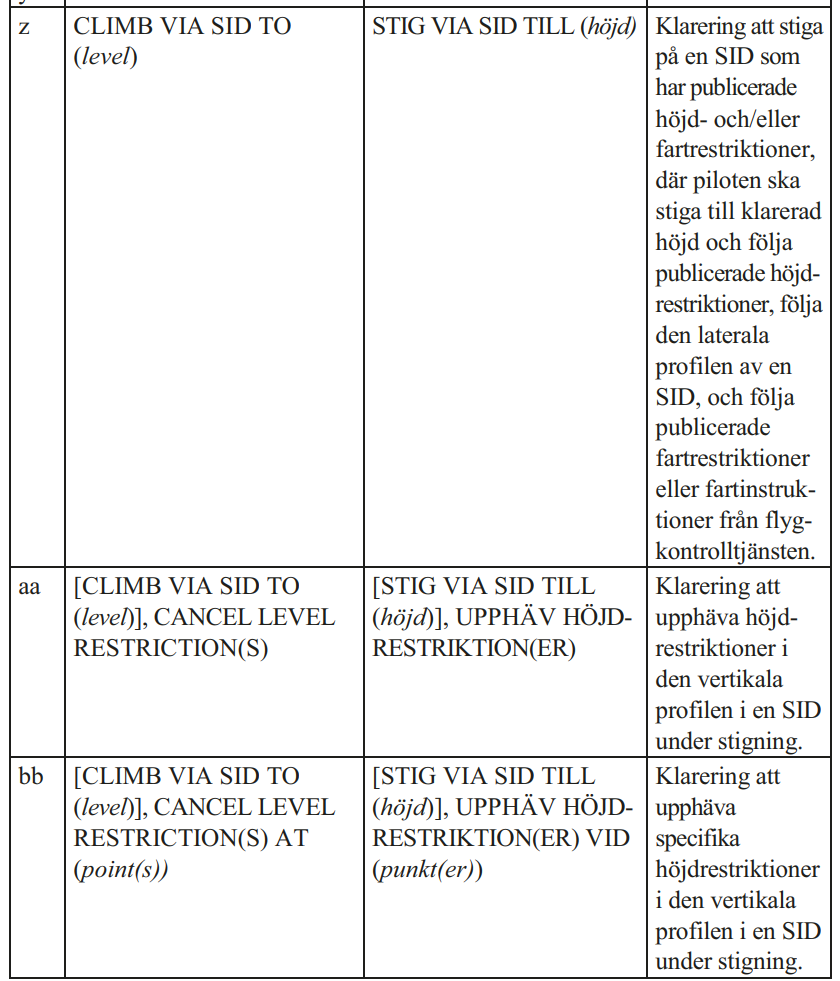
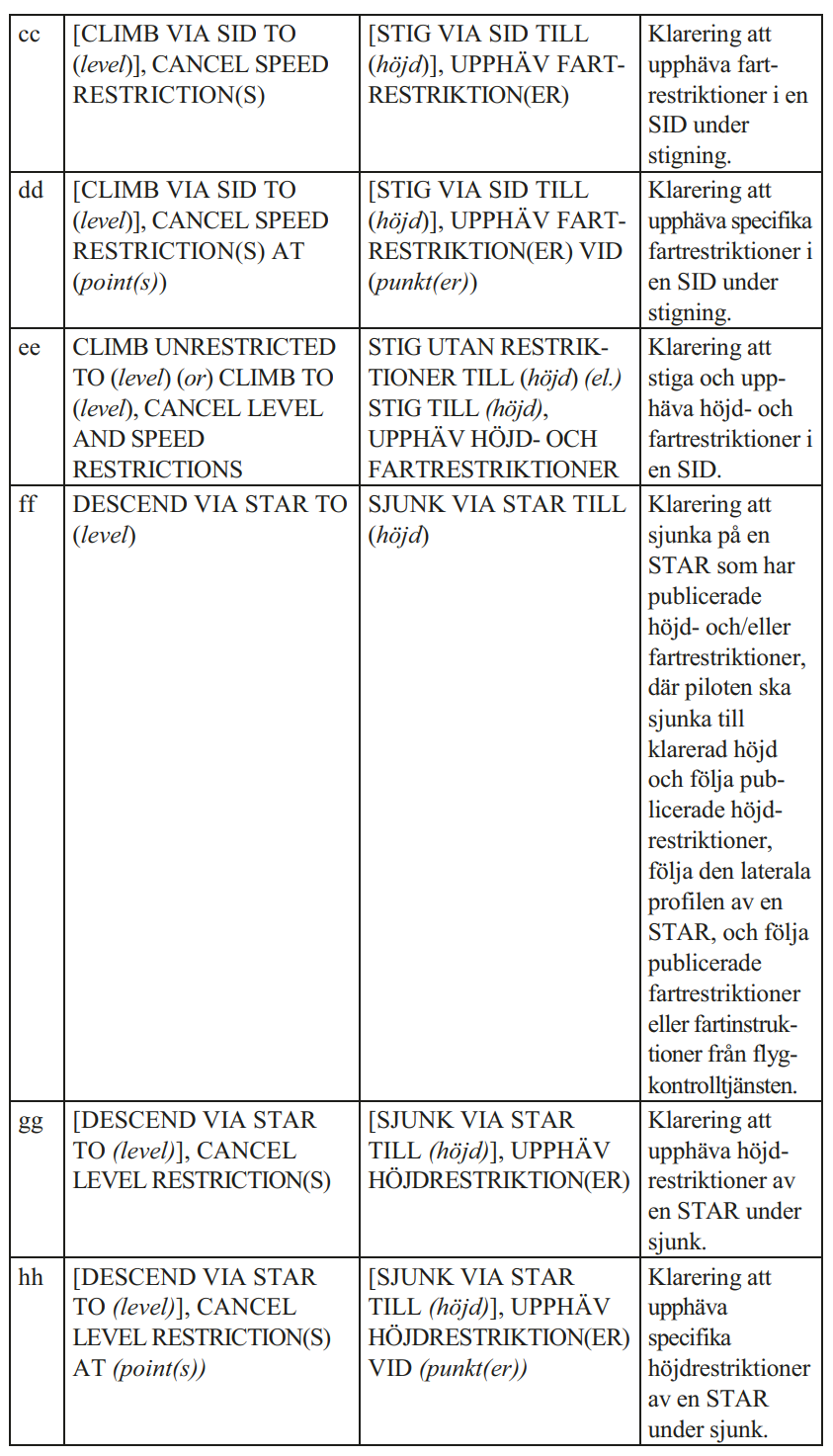
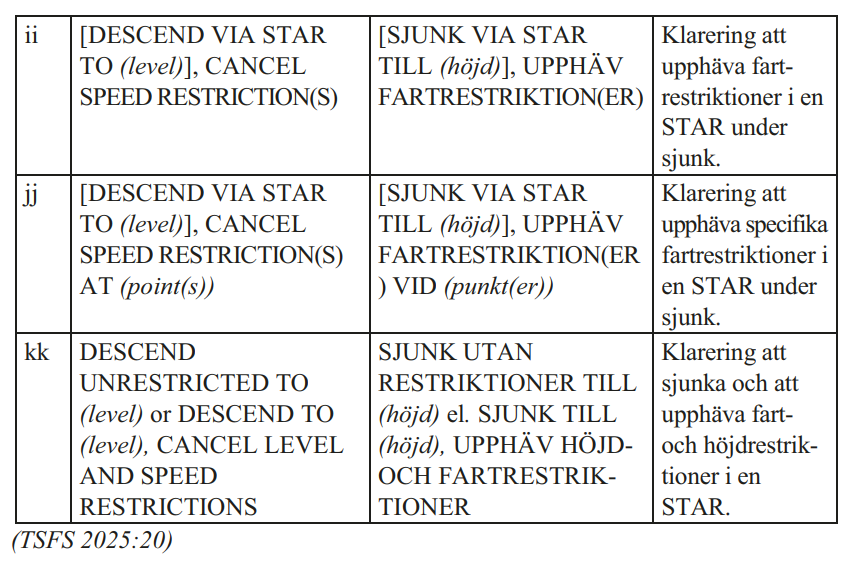
The full phraseology regulation can be found here.
ESSA: Established on RNP AR (EoR)
ESSA: Updated Appendix A and B with revised low speed departure routes, noise restrictions and runway selection table
Note: LPM Stockholm TMA has not been updated. Where there is a discrepancy between LPM and Appendix A/B the procedure in the Appendix is correct.
Appendix A and B have been updated with the following changes:
- Runway selection simplified as per real life procedures. There is now just one table. Enter the table in the relevant column (Peak, Off-Peak or Night) and select the most appropriate runway combination starting from the top. There are no longer set limits for wind direction/speed, but considerations to wind/WX conditions as well as RWY/TWY closures, WIP etc should be taken as described above the table.
- Noise restrictions added to Appendix B. The Introduction page lists all noise restrictions. Restrictions relevant to specific runway combinations are noted by each runway combination.
- New runway combinations with departures RWY 19L using E SID. These combinations are only used when ESR16 is active above 1600 ft, as departure RWY 19R as well as Q SID RWY 19L are not available in this condition.
- Low speed departure routes updated. Clarified initial track and final heading, and some tracks/headings changed. Note that in ARR 26/DEP 01L and ARR 26/DEP 26 there is no longer any specified heading/level for transfer from sector W to E. This should be tactically coordinated as needed. Also note that in ARR 26/DEP 19L-E, some low speed departures are cleared by DEL to 4000 ft.
- EoR breakout procedures and phraseology added to Appendix A.
ESSA/ESSB: HMR, TRS, COR, LNA replaced by new waypoints, closed STARs withdrawn
The following changes are effective from 22 January 2026:
Withdrawn NDBs and waypoints in ESSA/ESSB SID/STAR
NDBs withdrawn:
- COR (replaced by SOVAX)
- ERK (replaced by ERXEC)
- LNA (replaced by OBCIV)
New significant points:
- INWIQ (replacing TRS)
- VACRA (replacing HMR)
HMR and TRS VORs remain operational but are no longer used in ESSA/ESSB SID/STAR.
SID/STAR version numbers updated
Most SID/STAR have been updated with new version numbers to reflect the above changes.
Closed STARs withdrawn
The "closed" STARs that were published in AIP but never in operational use have been withdrawn and are no longer available.
Coordination between ESOS ACC and TWR/APP units
As the new GOP ACC is published, the following information regarding LOP ESOS ACC is provided here.
Coordination between ESOS ACC and Stockholm APP
Departing Traffic
- Stockholm APP must ensure a minimum of 5 NM, constant or increasing, surveillance separation before initiating transfer of traffic to ESOS ACC.
- Departing traffic is released to ESOS ACC for further climb if cleared to the LOP/LPM agreed level.
Arriving Traffic
- ESOS ACC must ensure a minimum of 5 NM, constant or increasing, surveillance separation before initiating transfer of traffic to Stockholm APP.
- Arriving traffic cleared to the LOP/LPM agreed level is released to Stockholm APP for further descent and speed control.
- When a turn release has been effected, traffic via ELTOK and XILAN may be turned more than 45°.
Note that traffic to/from Stockholm APP is not released for turn unless this has been coordinated either verbally or using Trf+Release.
Coordination between ESOS ACC and other TWR/APP units
Departing Traffic
TWR/APP units must ensure a minimum of 5 NM, constant or increasing, surveillance separation before initiating transfer of traffic to ESOS ACC.
Departing traffic is:
- Released to ACC for further climb if cleared to the LOP agreed level (usually FL90).
- Released to ACC for turn (±45°) upon passing 5000 ft.
Arriving Traffic
ESOS ACC must ensure a minimum of 5 NM, constant or increasing, surveillance separation before initiating transfer of traffic to TWR/APP.
Arriving traffic cleared to the LOP agreed level (usually FL100) is released to TWR/APP for further descent, turn (±45°) and speed control upon passing 20 NM from the TMA border.
NEW: ESSA pushback drop-points
New drop-points are introduced, in addition to the existing standard pushback procedures.
Drop-points will only be used for aircraft up to code C, equivalent to B737, A321.
Drop points are named after the taxiway they connect to, excluding the first letter. Where multiple drop points exist on the same taxiway, point 1 is closest to the manoeuvring area and point 2 is further into the apron.
ATS will indicate to the pilot who requests pushback:
Pushback to drop-point XX approved.
The drop-points can be displayed on the SMR using ALT+D, they are also included on the pushback map.
Do note that the drop points are not shown in the AIP, only in the pushback procedure manual on [vats.im/essadrop](http://vats.im/essadrop) or within VatIRIS.
Because of that, pilots are most probably not aware of the procedures.
.drop has been added as a text alias with a suitable message.